Alibaba Group BABA is building a much bigger AI story than simply developing another large language model. The company is expanding across the AI stack, from its Qwen models and proprietary chips to cloud infrastructure and overseas markets.
Its latest developments suggest that management is preparing for a much larger role in the global AI race. But with that ambition comes significant investment and execution risk. So, are these developments enough to make BABA stock more attractive after fiscal first-quarter 2027 earnings?
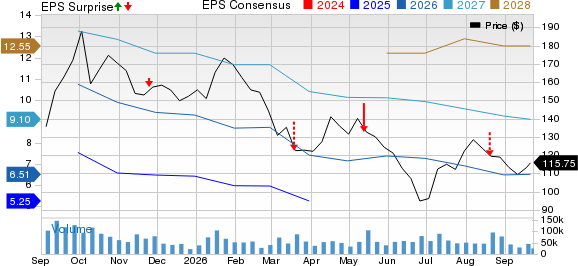
Alibaba Group Holding Limited Price, Consensus and EPS Surprise

Alibaba Group Holding Limited price-consensus-eps-surprise-chart | Alibaba Group Holding Limited Quote
Qwen Is Becoming a Bigger AI Asset
Alibaba’s Qwen family remains at the center of its AI strategy. The company is already working on Qwen 4, while future versions like Qwen 5 are designed to scale up to 10 trillion parameters.
Alibaba is also experimenting with recursive self-improvement (RSI), allowing its models to repeatedly refine aspects of their own development. Qwen 3.8-Max model has gone through 33 rounds of RSI, with each cycle allowing the system to improve the model further.
Alibaba’s New AI Chip
Alibaba is also moving deeper into AI infrastructure. Its Zhenwu V900 accelerator is expected to enter commercial use in 2027. Alibaba unveiled the chip yesterday, calling it China’s most powerful AI accelerator as it seeks to strengthen its position in the AI chip market. That matters because Alibaba wants to control more of the AI stack rather than relying entirely on external suppliers.
Alibaba Cloud Takes Its AI Push Global
Per South China Morning Post, Alibaba Cloud is expanding its international footprint, with new data centers planned in Turkey, Finland and the Netherlands. Additional capacity is coming to several existing markets, including Malaysia, Germany, the UAE, France and Hong Kong. This expansion will further broaden Alibaba Cloud’s international footprint as it looks to support rising demand for AI services outside China. The company currently operates 107 availability zones across 31 regions.
According to Gartner, BABA was the world’s fourth-largest cloud IaaS provider by revenues in 2025, behind Amazon AMZN, Microsoft MSFT and Google. Alibaba was the largest cloud IaaS provider in Asia-Pacific, with a 22.5% regional market share.
The company is also expanding its overseas AI product portfolio. Its new tools allow businesses to offer AI services under their own brands, combine multiple models for specific applications and create videos lasting up to an hour in more than 20 languages. Alibaba Cloud is also building partnerships to support its international expansion. Recent collaborations span sectors such as digital entertainment, logistics and enterprise software, giving Alibaba additional channels to bring its technology to businesses outside China.
The overseas push comes at a time when Alibaba Cloud is already seeing strong demand. External cloud revenue growth hit its highest level in several years, while AI-related products have maintained triple-digit year-over-year growth for 12 straight quarters. AI now accounts for more than one-third of Alibaba Cloud’s external revenues. Alibaba is targeting more than 20 GW of global data-center capacity by 2032, underscoring the scale of its ambition.
BABA’s Capex Woes
Alibaba’s AI ambitions require a significant upfront commitment. The company is already working through a RMB380 billion, three-year investment plan, with about RMB190 billion spent by the June quarter. A large portion of the spending is going toward AI infrastructure, including data centers and computing capacity, which means free cash flow is likely to remain under pressure as Alibaba continues expanding.
Our Take
Alibaba is clearly building a broader and more integrated AI ecosystem, with Qwen, chips, cloud infrastructure and international expansion reinforcing one another. Strong AI demand could create a meaningful long-term growth opportunity.
The Zacks Consensus Estimate for BABA’s fiscal 2027 and 2028 EPS implies year-over-year growth of roughly 67% and 40%, respectively.
 Image Source: Zacks Investment Research
Still, the scale of investment, uncertain timing of returns and ongoing profitability pressures leave room for execution risk. For now, BABA remains a Zacks Rank #3 (Hold) stock as investors weigh its significant AI opportunity against the capital intensity and time required to realize it.
You can see the complete list of today’s Zacks #1 Rank (Strong Buy) stocks here.
Zacks’ Research Chief Names “Stock Most Likely to Double”
Our team of experts has just released the 5 stocks with the greatest probability of gaining +100% or more in the coming months. Of those 5, Director of Research Sheraz Mian highlights the one stock set to climb highest.
Of course, all our elite picks aren’t winners, but this one could far surpass earlier Zacks’ Stocks Set to Double like D-Wave Quantum, which shot up +680.1%.
Free: See Our Top Stock And 4 Runners Up
Alibaba Group Holding Limited (BABA) : Free Stock Analysis Report
Amazon.com, Inc. (AMZN) : Free Stock Analysis Report
Microsoft Corporation (MSFT) : Free Stock Analysis Report
This article originally published on Zacks Investment Research (zacks.com).
5 Stocks Our Experts Predict Could Double In the Next Year
By submitting your email, you'll also get a free pivot & flow membership. A free daily market overview. You can unsubscribe at any time.