Alibaba BABA is scheduled to report first-quarter fiscal 2027 results on Aug. 20.
For the fiscal first quarter, the Zacks Consensus Estimate for revenues is pegged at $38.63 billion, suggesting an 11.74% rise from the year-ago quarter’s reported figure.
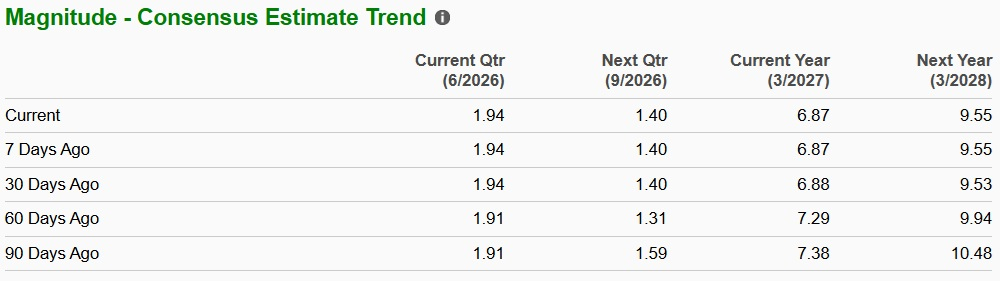
The Zacks Consensus Estimate for earnings is pinned at $1.94 per share, indicating a decline of 5.83% from the prior-year quarter’s reported figure.
Alibaba has a negative earnings surprise history. In the last reported quarter, the company delivered a negative earnings surprise of 92.62%. Its earnings missed the Zacks Consensus Estimate in each of the trailing four quarters, the average negative surprise being 37.65%.
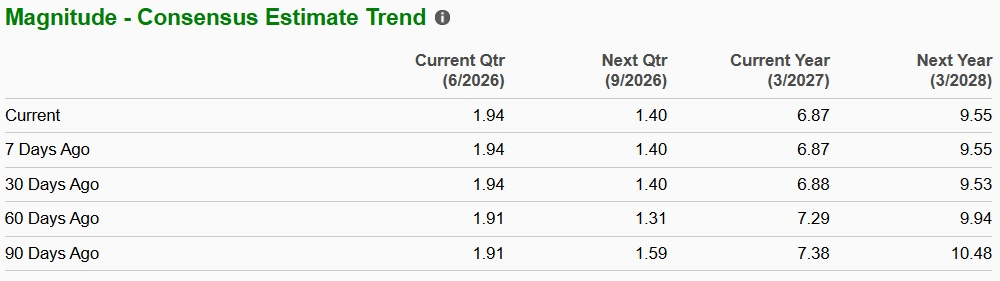
Image Source: Zacks Investment Research
Earnings Whispers for BABA
Our proven model does not conclusively predict an earnings beat for Alibaba this time around. The combination of a positive Earnings ESP and a Zacks Rank #1 (Strong Buy), 2 (Buy) or 3 (Hold) increases the odds of an earnings beat. This is not the case here. You can uncover the best stocks to buy or sell before they are reported with our Earnings ESP Filter.
BABA has an Earnings ESP of 0.00% and a Zacks Rank #3 at present. You can see the complete list of today’s Zacks #1 Rank stocks here.
Alibaba Group Holding Limited Price and EPS Surprise

Alibaba Group Holding Limited price-eps-surprise | Alibaba Group Holding Limited Quote
Factors to Note for BABA Ahead of Q1 Results
Alibaba enters its first-quarter fiscal 2027 results, covering April through June 2026, against a backdrop of accelerating cloud momentum but continued margin compression from aggressive AI and quick commerce investment. Management guided that Cloud Intelligence Group’s external revenue growth, which reached 40% in the March quarter, was expected to remain a key growth engine, with AI-related product revenues targeting a 12th consecutive quarter of triple-digit expansion. Customer management revenues, which grew 8% year over year on a like-for-like basis excluding the new merchant subsidy program, were likely to have continued benefiting from improved take rates, even as reported CMR growth stayed muted due to the contra-revenue accounting change.
Within the China e-commerce business, quick commerce unit economics are expected to have continued improving sequentially, supported by order-mix optimization and logistics efficiency, with management reiterating confidence that unit economics would turn positive by the end of fiscal 2027. The Qwen consumer app’s integration with Taobao and Tmall commerce services, completed in early May, extended AI-driven shopping assistance to a broader user base, while 88VIP membership continued expanding past 62 million. However, heavy subsidy spending and user-acquisition costs for quick commerce and Qwen remained headwinds to near-term adjusted EBITA and free cash flow, which had swung to an outflow in the prior quarter. Intensifying domestic rivalry in instant retail remained a further headwind to monetization.
On the AI and cloud front, Alibaba Cloud continued scaling its Model-as-a-Service platform and proprietary T-Head chip deployments, while capital expenditure was expected to run above the previously stated three-year RMB380 billion AI infrastructure budget, reflecting rising compute demand. This capex intensity, alongside elevated technology and marketing spend, remained a headwind to consolidated adjusted EBITA and non-GAAP net income, both of which had declined sharply in the preceding quarter.
Alibaba International Digital Commerce Group’s losses are expected to have kept narrowing toward breakeven, aided by AliExpress’ Choice business efficiency gains and the expanding “Brand+” merchant program. Corporate developments during the quarter included the May 20 filing of Alibaba’s fiscal 2026 annual report on Form 20-F, and a May 29 multi-year sponsorship partnership with UEFA men’s club competitions and EURO 2028, both reinforcing brand visibility. A fiscal 2026 annual dividend of $1.05 per ADS was paid in July.
Overall, the quarter’s results, due Aug. 20, are likely to reflect a continuation of the group’s trade-off between AI-driven top-line acceleration and near-term profitability pressure, with investors watching capex trajectory and quick commerce breakeven progress.
BABA Price Performance & Stock Valuation
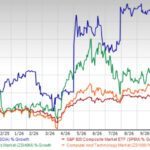
BABA shares have plunged 13.1% year to date, underperforming the Zacks Internet – Commerce industry and the Zacks Retail-Wholesale sector’s growth of 6.5% and 4%, respectively.
BABA faces tough competition from Amazon AMZN, PDD Holdings PDD and JD.com JD. Shares of Amazon have returned 12% while JD.com and PDD Holdings have lost 1.2% and 23.9% during the same period.
BABA’s Share Price Performance
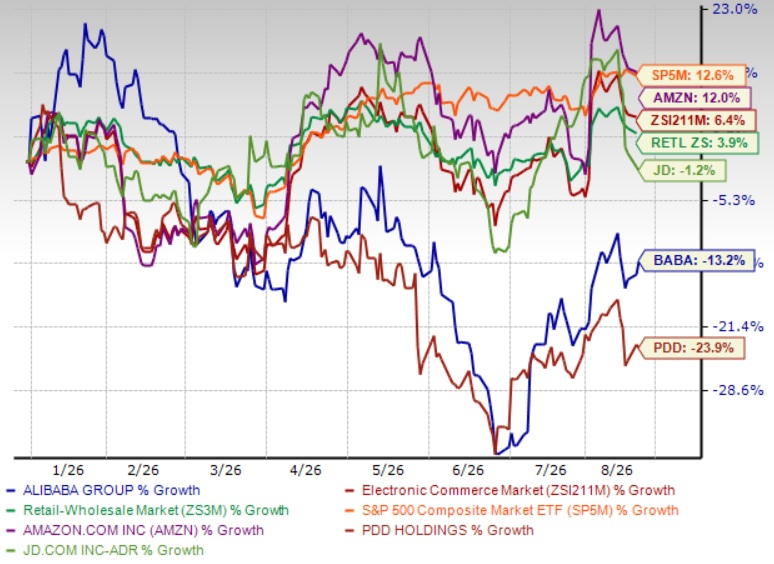
Image Source: Zacks Investment Research
BABA has a Value Score of C, which suggests stretched valuation. BABA stock is currently trading at a trailing 12-month Price/Earnings of 39.47X compared with the sector’s 29.23X.
BABA’s P/E TTM Ratio Depicts Stretched Valuation
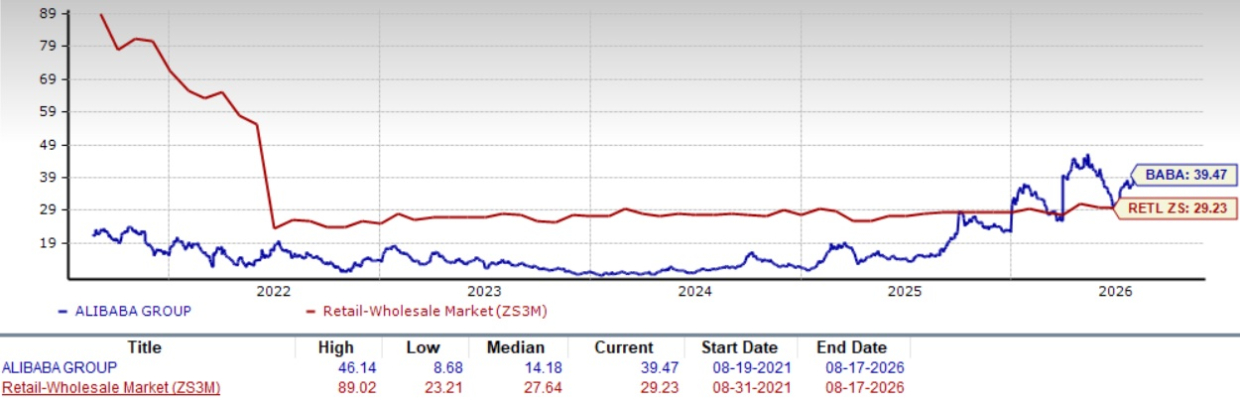
Image Source: Zacks Investment Research
Investment Thesis
Alibaba’s fiscal 2027 first-quarter setup reflects a balanced risk-reward profile ahead of results due Aug. 20. Cloud Intelligence Group’s accelerating external revenue growth and 11th-plus consecutive quarter of triple-digit AI product growth support a durable long-term monetization story, while customer management revenues underlying 8% like-for-like growth signal resilient core commerce demand. However, elevated capex likely exceeding the RMB380 billion AI infrastructure budget, persistent quick commerce subsidy spending, and compressed adjusted EBITA margins remain near-term profitability headwinds. Combined with a premium valuation relative to peers and stiff competition in instant retail and cloud, investors may find the risk-reward balanced rather than compelling until unit economics and capex discipline show clearer improvement.
Conclusion
Alibaba’s AI and cloud momentum remains encouraging, but elevated capex, subsidy-driven margin pressure and stiff competition warrant caution ahead of the first quarter fiscal 2027 results. Given the stock’s premium valuation against near-term earnings uncertainty, existing investors may consider holding positions through the print, while prospective buyers could wait for clearer signs of margin stabilization before establishing a new entry point.
Radical New Technology Could Hand Investors Huge Gains
Quantum Computing is the next technological revolution, and it could be even more advanced than AI.
While some believed the technology was years away, it is already present and moving fast. Large hyperscalers, such as Microsoft, Google, Amazon, Oracle, and even Meta and Tesla, are scrambling to integrate quantum computing into their infrastructure.
Senior Stock Strategist Kevin Cook reveals 7 carefully selected stocks poised to dominate the quantum computing landscape in his report, Beyond AI: The Quantum Leap in Computing Power.
Kevin was among the early experts who recognized NVIDIA’s enormous potential back in 2016. Now, he has keyed in on what could be “the next big thing” in quantum computing supremacy. Today, you have a rare chance to position your portfolio at the forefront of this opportunity.
Alibaba Group Holding Limited (BABA) : Free Stock Analysis Report
Amazon.com, Inc. (AMZN) : Free Stock Analysis Report
JD.com, Inc. (JD) : Free Stock Analysis Report
PDD Holdings Inc. Sponsored ADR (PDD) : Free Stock Analysis Report
This article originally published on Zacks Investment Research (zacks.com).
5 Stocks Our Experts Predict Could Double In the Next Year
By submitting your email, you'll also get a free pivot & flow membership. A free daily market overview. You can unsubscribe at any time.