Key Points
Sandisk (NASDAQ: SNDK) has been by far the best-performing S&P 500 (SNPINDEX: ^GSPC) stock in 2026 with a 544% year to date gain as of the market close on Aug. 13. Sandisk is followed by Dell Technologies, Seagate Technology, Micron Technology (NASDAQ: MU) — which now has a market cap of more than $1 trillion — Intel, Western Digital, Marvell Technology, Hewlett Packard Enterprise, Lumentum, and Advanced Micro Devices. So the 10 best-performing S&P 500 stocks are all tech stocks with significant exposure to the boom in artificial intelligence (AI) spending.
Given that concentration, you may think that large-cap tech stocks are driving the market to new heights. But surprisingly, small-cap stocks are outperforming mid-, large-, and mega-cap stocks in 2026 — as well as the S&P 500 and Nasdaq-100 — which is the largest non-financial companies by market cap in the Nasdaq Composite (NASDAQINDEX: ^IXIC)
Missed Nvidia in 2009? This Rare Signal Is Flashing Again. In 2009, a “Double Down” signal flashed for a little-known chipmaker called Nvidia. For the first time in years, that same “Total Conviction” signal is flashing for a company 1/100th the size of Nvidia. Continue »
Here’s why the Vanguard Morningstar Small-Cap ETF (NYSEMKT: VB) presents one of the best ways to invest in small-cap stocks, and why the exchange-traded fund could be a buy now.

Image source: Getty Images.
An AI-driven rally
In 2022, the S&P 500 fell 19%, and the Nasdaq-100 fell 33%, as investors questioned valuations and digested inflationary pressures. But on Nov. 30, 2022, OpenAI released ChatGPT for free. What has followed has been nothing short of paradigm-shifting momentum in the U.S. stock market — driven largely by artificial intelligence (AI), the technology sector, and mega-cap growth stocks.
The gains were so large that Bank of America analyst Michael Hartnett popularized the term “Magnificent Seven” in 2023 to describe seven tech-fueled mega-cap growth stocks — Nvidia (NASDAQ: NVDA), Apple, Alphabet, Microsoft, Amazon, Meta Platforms, and Tesla. The AI-driven rally has expanded significantly beyond the Magnificent Seven, with the biggest winners in 2026 largely companies benefiting from record AI capital spending — from memory chip stocks to networking companies to semiconductor equipment makers.
Changing of the guard
Despite the rallies in tech stocks like Sandisk and Micron, there has been a slowdown in the mega-cap dominance. In fact, Nvidia and Amazon are the only Magnificent Seven stocks that are outperforming the S&P 500 year to date — and Meta Platforms and Tesla have declined.
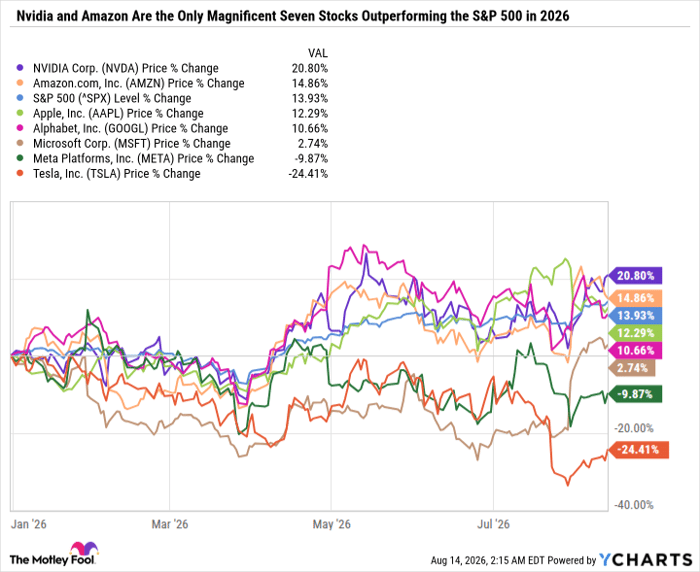
Big gains in semiconductor stocks have certainly contributed to strong 2026 performances in the S&P 500 and Nasdaq-100. But dig deeper, and there’s an equally interesting force at play — which is the rebound in mid- and small-cap stocks.
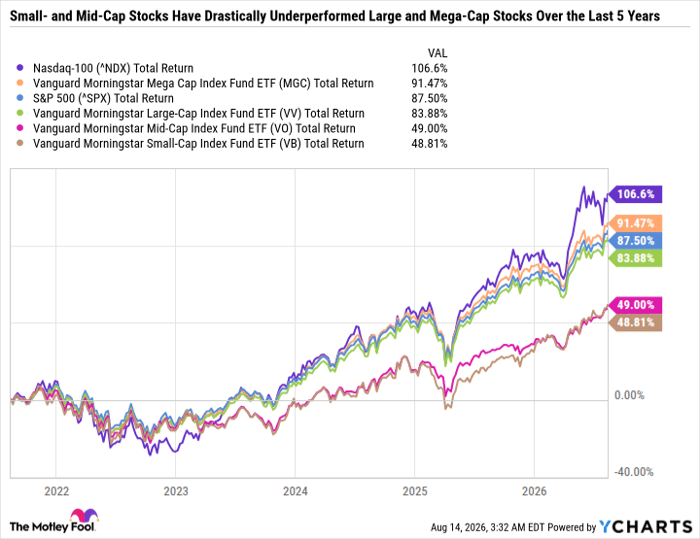
The boom in AI growth stocks coincided with the Nasdaq-100 more than doubling during the past five years, which is particularly impressive considering that period includes the 2022 sell-off. At the same time, small-cap stocks were drastically underperforming their large-cap peers. But in 2026, small caps are doing better than other large and mega-caps, as well as the major indexes.
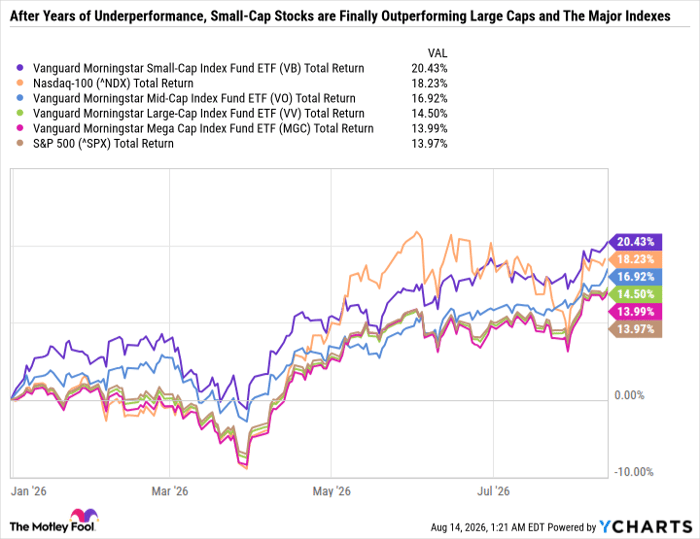
VB Total Return Level data by YCharts
Small-cap stocks remain a good value
Funds like the Vanguard Morningstar Small-Cap ETF tend to perform well when investors question mega-cap growth stock valuations and shift toward value stocks. Even after its strong performance in 2026, the Small-Cap ETF features a mere 22.3 price-to-earnings (P/E) ratio, which is noticeably lower than the Vanguard S&P 500 ETF‘s (NYSEMKT: VOO) 27.5 P/E ratio.
Unlike the S&P 500, which has more than half of its weighting in just 5% of its holdings, the Vanguard Small-Call ETF has 1,311 holdings, and the largest holding makes up just 0.54% of the fund. Top holdings in the Vanguard S&P 500 ETF include well-known companies like Nvidia, Alphabet, and Apple — which make up a combined 20.5% of the ETF. The top holdings in the Vanguard Morningstar Small-Cap ETF are companies you may have never heard of, like Credo Technology, Jabil, Revolution Medicines, and Astera Labs.
The easiest way to visualize the difference between the Small-Cap ETF and the S&P 500 ETF is to look at their sector components.
Sector | Vanguard Morningstar Small-Cap ETF | Vanguard S&P 500 ETF |
|---|---|---|
Industrials | 22.4% | 8.8% |
Technology and Communications | 16.8% | 47.7% |
Consumer Discretionary | 12.8% | 9.3% |
Financials | 12.3% | 11.8% |
Healthcare | 12.3% | 8.9% |
Real Estate | 7.4% | 1.8% |
Basic Materials | 4.7% | 1.8% |
Energy | 4.4% | 3% |
Utilities | 3.6% | 2.2% |
Consumer Staples | 3.3% | 4.6% |
Other | 0% | 0.1% |
Data source: Vanguard.
As you can see in the table, the Vanguard S&P 500 ETF has a far higher weighting in technology and communications than the Small-Cap ETF, which is highly concentrated in value and cyclically focused sectors. In addition to having a lower valuation, the Small-Cap ETF also has a higher dividend yield of 1.3%, compared to just 1% for the Vanguard S&P 500 ETF. And both ETFs have identical 0.03% expense ratios — which is just $0.30 for every $1,000 invested.
A good ETF for value investors
The best reason to invest in an ETF is if it fills a particular need in your portfolio — especially one that is hard to replicate through buying individual stocks. If your portfolio is already built around mega- and large-cap S&P 500 stocks, then buying the Vanguard S&P 500 ETF can be redundant and duplicate existing holdings. Whereas the Vanguard Small-Cap ETF would provide significant diversification, as many of its holdings are stocks you may be less familiar with.
In sum, the Vanguard Small-Cap ETF is a good buy for investors looking for an ultra-low-cost way to get exposure to a basket of more than 1,000 stocks — most of which they probably don’t already own.
Should you buy stock in Vanguard Morningstar Small-Cap ETF right now?
Before you buy stock in Vanguard Morningstar Small-Cap ETF, consider this:
The Motley Fool Stock Advisor analyst team just identified what they believe are the 10 best stocks for investors to buy now… and Vanguard Morningstar Small-Cap ETF wasn’t one of them. The 10 stocks that made the cut could produce monster returns in the coming years.
Consider when Netflix made this list on December 17, 2004… if you invested $1,000 at the time of our recommendation, you’d have $421,511!* Or when Nvidia made this list on April 15, 2005… if you invested $1,000 at the time of our recommendation, you’d have $1,381,960!*
Now, it’s worth noting Stock Advisor’s total average return is 981% — a market-crushing outperformance compared to 216% for the S&P 500. Don’t miss the latest top 10 list, available with Stock Advisor, and join an investing community built by individual investors for individual investors.
*Stock Advisor returns as of August 18, 2026.
Bank of America is an advertising partner of Motley Fool Money. Daniel Foelber has positions in Nvidia and has the following options: short August 2026 $240 calls on Nvidia. The Motley Fool has positions in and recommends Advanced Micro Devices, Alphabet, Amazon, Apple, Hewlett Packard Enterprise, Intel, Lumentum, Marvell Technology, Meta Platforms, Micron Technology, Microsoft, Nvidia, Tesla, Vanguard S&P 500 ETF, and Western Digital. The Motley Fool recommends Astera Labs. The Motley Fool has a disclosure policy.
5 Stocks Our Experts Predict Could Double In the Next Year
By submitting your email, you'll also get a free pivot & flow membership. A free daily market overview. You can unsubscribe at any time.