Key Points
In recent years, the “Magnificent Seven” stocks were not cheap. These top tech stocks, each involved to some degree in the booming field of artificial intelligence (AI), soared, even driving gains in the S&P 500. And as this happened, these stocks became pricier and pricier. Investors piled into these companies as they represented a great way to bet on the potential of AI.
Though these hot tech companies have continued to gain, they encountered some turbulence in recent months — from general concerns about the economy to questions about the strength of the AI growth story — and all of this has pushed valuations down. So today, the “Magnificent Seven” players aren’t as expensive as they once were. In fact, certain ones are even trading at bargain levels.
Missed Nvidia in 2009? This Rare Signal Is Flashing Again. In 2009, a “Double Down” signal flashed for a little-known chipmaker called Nvidia. For the first time in years, that same “Total Conviction” signal is flashing for a company 1/100th the size of Nvidia. Continue »
Among these, which “Magnificent Seven” stock represents a once-in-a-decade buying opportunity right now? Here’s a hint: It’s the one you’d least expect.

Image source: Getty Images.
Major players in the AI story
So, let’s start out by identifying this group of winning tech stocks. They are:
- Amazon
- Apple
- Alphabet
- Microsoft
- Meta Platforms
- Nvidia (NASDAQ: NVDA)
- Tesla
These players have climbed in recent years as they’ve played roles in the AI story, from offering cloud services and AI assistants to designing chips. And many have generated significant revenue from their products and services, well into the billions of dollars.
In recent months, though, various concerns weighed on the minds of investors and even prompted a rotation out of some of these top AI players. As a result, their valuations have come down — and in certain cases, they’ve reached bargain basement levels. I don’t think these levels will last forever because the AI growth story remains intact, as we’ve seen through recent earnings reports — including the latest from Micron Technology. This stock isn’t a member of the “Magnificent Seven,” but it’s proven itself to be one of the winners of the AI boom.
Micron, a memory and storage company, saw revenue and profit soar in the quarter and spoke of high demand. This is a message that’s very similar to those delivered by “Magnificent Seven” companies in recent weeks as they reported earnings.
Valuation may climb
And this offers us reason to be optimistic about earnings ahead for these companies — and the future performance of their stock prices. So, it’s very likely that valuation, from today’s low levels, will head higher.
Which of the “Magnificent Seven” is a once-in-a-decade buying opportunity right now, trading at a dirt cheap valuation? It may surprise you to know that it’s one of the most profitable AI companies and one that’s driven this AI revolution so far. I’m talking about Nvidia.
The stock is trading at 21x forward earnings estimates, down from more than 48x early last year.
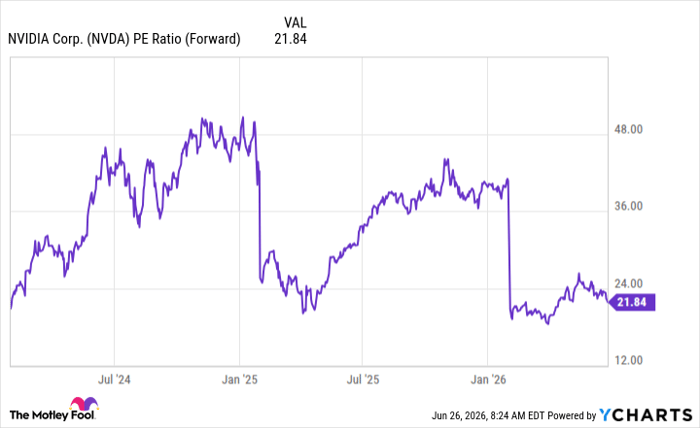
NVDA PE Ratio (Forward) data by YCharts
It’s important to remember that Nvidia reported revenue topping $215 billion in the latest fiscal year, and in the recent quarter, revenue soared to a record $81 billion. Profitability on sales remains only behind that of Micron: Micron just reported gross margin of 84%, while Nvidia’s came in at more than 74% in the latest quarter. Nvidia also has demonstrated its ability to consistently generate high margins, with the metric topping 70% quarter after quarter.
Though Nvidia saw growth explode dramatically in the earliest days of the AI boom, the company may be heading for a new wave of growth in the months to come. The tech giant is set to roll out its latest update, the Vera Rubin system, and launch its first stand-alone central processing units (CPUs). The CPU release could be a big moment for Nvidia as this market represents new territory to conquer — and territory worth more than $200 billion. Nvidia said in the latest earnings report that it’s on track to dominate.
That, along with the company’s current leadership in graphics processing units (GPUs), the AI chips that set Nvidia off on the path to general AI leadership, suggests another important chapter is just ahead. And that’s why Nvidia, trading at today’s price, offers investors a once-in-a-decade buying opportunity.
Should you buy stock in Nvidia right now?
Before you buy stock in Nvidia, consider this:
The Motley Fool Stock Advisor analyst team just identified what they believe are the 10 best stocks for investors to buy now… and Nvidia wasn’t one of them. The 10 stocks that made the cut could produce monster returns in the coming years.
Consider when Netflix made this list on December 17, 2004… if you invested $1,000 at the time of our recommendation, you’d have $398,052!* Or when Nvidia made this list on April 15, 2005… if you invested $1,000 at the time of our recommendation, you’d have $1,181,688!*
Now, it’s worth noting Stock Advisor’s total average return is 892% — a market-crushing outperformance compared to 205% for the S&P 500. Don’t miss the latest top 10 list, available with Stock Advisor, and join an investing community built by individual investors for individual investors.
*Stock Advisor returns as of June 29, 2026.
Adria Cimino has positions in Amazon and Tesla. The Motley Fool has positions in and recommends Alphabet, Amazon, Apple, Meta Platforms, Micron Technology, Microsoft, Nvidia, and Tesla. The Motley Fool has a disclosure policy.
5 Stocks Our Experts Predict Could Double In the Next Year
By submitting your email, you'll also get a free pivot & flow membership. A free daily market overview. You can unsubscribe at any time.