Key Points
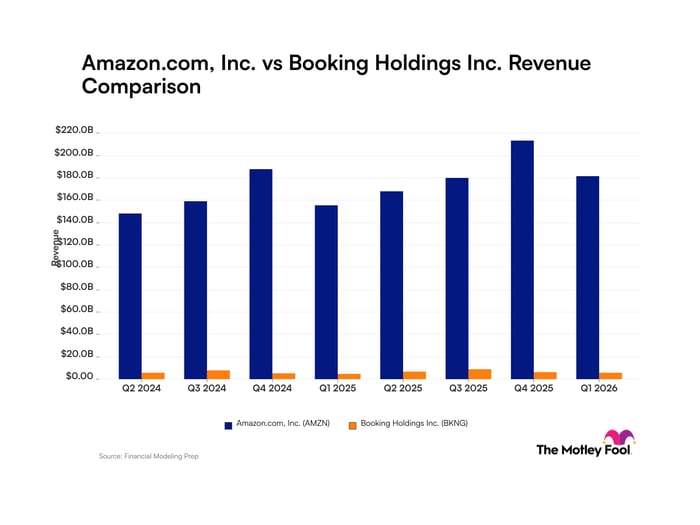
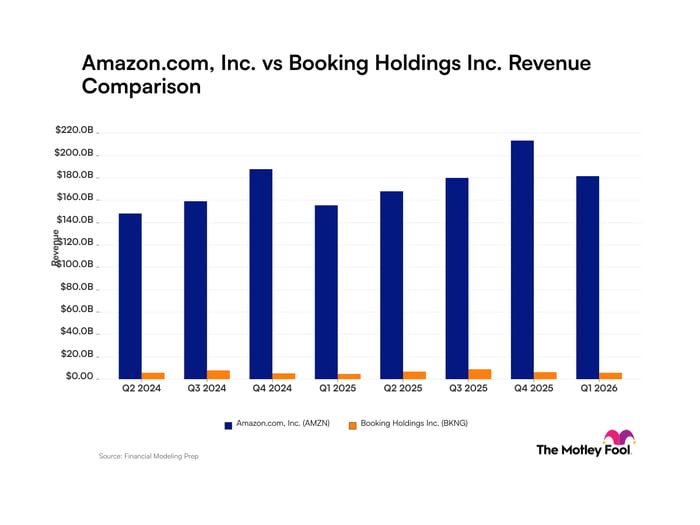
Amazon currently operates at a vastly higher revenue scale than Booking, maintaining a massive financial advantage across the entire observed period.
Over roughly the last eight quarters, Amazon demonstrated generally positive quarter-over-quarter trajectories, while Booking experienced alternating periods of sharp revenue expansion and contraction.
Investors should watch whether these differing quarter-over-quarter volatility patterns persist or if the revenue gap between the two companies fundamentally shifts over time.
- 10 stocks we like better than Amazon ›
Amazon: Sustaining Broad Revenue Scale
Amazon (NASDAQ:AMZN) primarily generates revenue by selling diverse consumer goods online, operating physical retail stores, and providing cloud computing solutions to global enterprise clients.
It introduced Amazon Supply Chain Services to open its internal logistics network to third-party businesses in May 2026, and it reported a 17% net income margin for the quarter ended March 31, 2026.
Booking: Navigating Cyclical Travel Revenue
Booking (NASDAQ:BKNG) mainly earns revenue by facilitating online travel accommodations, flight bookings, car rentals, and restaurant reservations across its multiple digital platforms for individual consumers.
It integrated new artificial intelligence booking tools into its platforms in mid-2026 while simultaneously managing workforce reductions, and it generated a 23% EBIT margin for the quarter ended March 31, 2026.
Why Revenue Matters for Retail Investors
Revenue represents the total amount of money a company brings in from selling its goods or services before any expenses are deducted, and it matters because it serves as the foundational indicator of customer demand and overall business growth.
Quarterly Revenue for Amazon and Booking
| Quarter (Period End) | Amazon Revenue | Booking Revenue |
|---|---|---|
| Q2 2024 (June 2024) | $148.0 billion | $5.9 billion |
| Q3 2024 (Sept. 2024) | $158.9 billion | $8.0 billion |
| Q4 2024 (Dec. 2024) | $187.8 billion | $5.5 billion |
| Q1 2025 (March 2025) | $155.7 billion | $4.8 billion |
| Q2 2025 (June 2025) | $167.7 billion | $6.8 billion |
| Q3 2025 (Sept. 2025) | $180.2 billion | $9.0 billion |
| Q4 2025 (Dec. 2025) | $213.4 billion | $6.3 billion |
| Q1 2026 (March 2026) | $181.5 billion | $5.5 billion |
Data source: Company filings. Data as of July 24, 2026.
Foolish Take
Examining the revenue trends for Amazon and Booking Holdings reveal the quirks in their businesses. The fourth quarter is the largest in terms of sales for the former, thanks to the winter holiday shopping season, while the latter sees its biggest revenue quarter during the summer travel time.
Both are seeing a trend of strong sales expansion. Amazon’s $181.5 billion in its most recent quarter was a 17% year-over-year increase. Booking’s $5.5 billion represented 16% year-over-year growth.
While revenue trends indicate healthy businesses, Booking warned the U.S. conflict with Iran is expected to hurt sales just as the 2026 travel season is ramping up. This caused the company’s stock to drop to a 52-week low of $150.14 in May. The dip creates a buy opportunity.
Amazon’s share price fell from its 52-week high of $278.56 reached in May due to its massive capital expenditures to provide the tech infrastructure needed to grow its artificial intelligence business. Its spending caused Q1 free cash flow to plunge 95% year over year, but the expense is helping to fuel its AWS cloud computing division’s revenue growth, which rose 28% year over year in Q1. Its share price drop also presents investors with an opportunity to pick up shares.
Should you buy stock in Amazon right now?
Before you buy stock in Amazon, consider this:
The Motley Fool Stock Advisor analyst team just identified what they believe are the 10 best stocks for investors to buy now… and Amazon wasn’t one of them. The 10 stocks that made the cut could produce monster returns in the coming years.
Consider when Netflix made this list on December 17, 2004… if you invested $1,000 at the time of our recommendation, you’d have $377,990!* Or when Nvidia made this list on April 15, 2005… if you invested $1,000 at the time of our recommendation, you’d have $1,269,518!*
Now, it’s worth noting Stock Advisor’s total average return is 896% — a market-crushing outperformance compared to 206% for the S&P 500. Don’t miss the latest top 10 list, available with Stock Advisor, and join an investing community built by individual investors for individual investors.
*Stock Advisor returns as of July 25, 2026.
Robert Izquierdo has positions in Amazon. The Motley Fool has positions in and recommends Amazon and Booking Holdings. The Motley Fool has a disclosure policy.
5 Stocks Our Experts Predict Could Double In the Next Year
By submitting your email, you'll also get a free pivot & flow membership. A free daily market overview. You can unsubscribe at any time.