Key Points
The Roundhill Magnificent Seven ETF has strongly outperformed the iShares Russell 2000 Growth ETF for the past three years, but the future could be brighter for small caps.
Meta Platforms and Microsoft shares have delivered negative returns for the past year, lagging the rest of the “Magnificent Seven” stocks.
In case the Magnificent Seven theme is past its prime, broad diversification across more than 1,000 small caps might be a better strategy for long-term investors.
- 10 stocks we like better than Roundhill Magnificent Seven ETF ›
The “Magnificent Seven” are among the largest, most successful, and best-known household-name tech stocks in America. But so far in 2026, investors would have been better off owning an exchange-traded fund (ETF) that holds more than 1,000 small-cap stocks most people have never heard of.
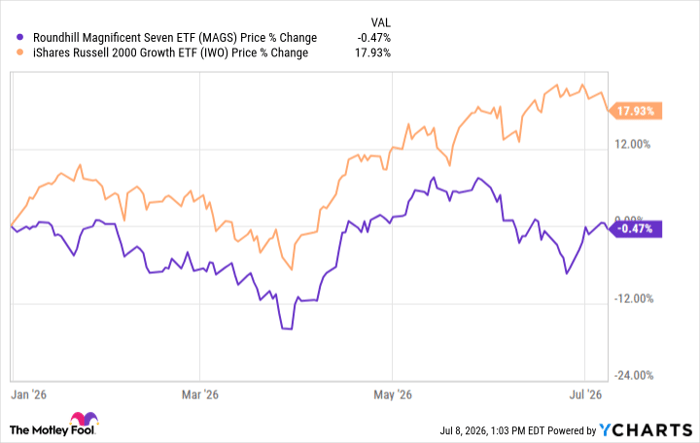
That’s right. Shares of the Roundhill Magnificent Seven ETF (NYSEMKT: MAGS) have lost about 0.5% year to date, while the iShares Russell 2000 Growth ETF (NYSEMKT: IWO) of small-cap stocks has gained about 17%.
Missed Nvidia in 2009? This Rare Signal Is Flashing Again. In 2009, a “Double Down” signal flashed for a little-known chipmaker called Nvidia. For the first time in years, that same “Total Conviction” signal is flashing for a company 1/100th the size of Nvidia. Continue »
What’s driving this shift from seven of the biggest tech names toward small-cap growth stocks? And which ETF is a better buy for long-term investors? Let’s take a closer look at these two very different ETFs and see which could be the best choice for your portfolio.

Image source: Getty Images.
Roundhill Magnificent Seven ETF (MAGS): Seven tech majors, three years of 29.7% annualized returns
The Roundhill Magnificent Seven ETF has a straightforward portfolio construction: It holds all seven Magnificent Seven stocks with equal-weight exposure In case anyone needs a refresher on the Magnificent Seven, the Magnificent Seven are Alphabet, Amazon, Apple, Meta Platforms, Microsoft, Nvidia, and Tesla.
In the past three years, this fund has delivered average annual returns (by net asset value) of 29.7%. But more recently, its returns have been less strong. It has underperformed the S&P 500 index for the past year.
What’s driving the recent slowdown in the Magnificent Seven ETF? Not all Magnificent Seven stocks have been winners lately. If you look at the performance of all seven stocks over the past year, there has been a significant gap between companies like Alphabet (101% gain) and Apple (48% gain), while Meta has lost 15.9% and Microsoft is down 23.3%.
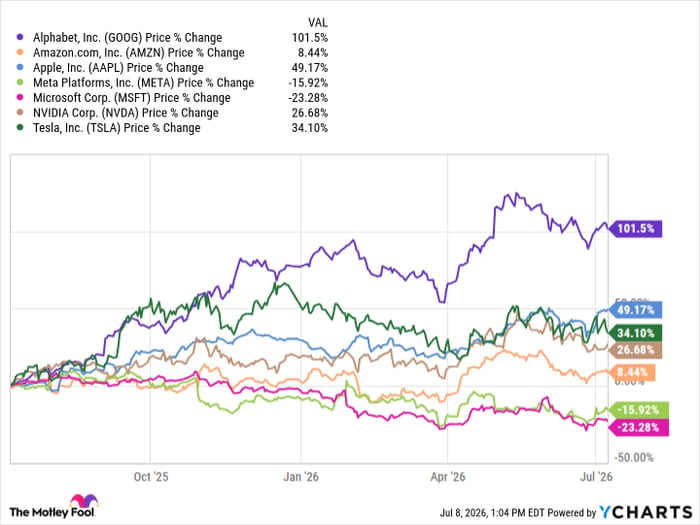
Buying the Roundhill Magnificent Seven ETF requires investors to make a concentrated bet on seven companies that might not have enough in common anymore. For example, if you believe that Alphabet is poised to be a big winner of the artificial intelligence (AI) boom, but you’re skeptical about Meta’s AI strategy and worried that Microsoft is spending too much on AI capex, you probably shouldn’t buy all three of those companies in the same ETF with the same weightings.
Just because all seven of these stocks were great to own for the past few years doesn’t mean they’re all a good buy today. The Roundhill Magnificent Seven ETF might be a strategic mismatch for many long-term investors.
iShares Russell 2000 Growth ETF (IWO): 1,118 stocks, three years of 18.3% annualized returns
Small-cap stocks are having a moment right now. Recent research from Fidelity said that U.S. small caps are looking undervalued relative to large caps. So chances are better that small caps can outperform large caps in the next five to 10 years.
Just like with major tech stocks, there are no guarantees. No one knows which small-cap stocks or ETFs will do best in the future. But if you want to invest in a broadly diversified portfolio of smaller companies that are forecasted to deliver high sales growth, the iShares Russell 2000 Growth ETF fits that strategy.
This ETF holds 1,118 U.S. small-cap growth stocks and has delivered average annual returns of 11.9% for the past 10 years, 5.5% for the past five years, 18.3% for the past three years, and an impressive 38.6% return in the past year.
If you want to diversify your portfolio away from the tech sector (which some investors worry has become overvalued), this ETF could be a good fit. Its top-five sector holdings are healthcare (30.02% of the fund), information technology (19.02%), industrials (16.3%), financials (9.72%), and consumer discretionary (8.74%). That’s a much broader mix of the U.S. economy than just seven major tech names.
Why buy IWO instead of MAGS
I don’t own either of these funds, but if I had to choose one today, I would go with the iShares Russell 2000 Growth ETF. Buying more than 1,000 up-and-coming small-cap companies seems like a better strategic move than investing too heavily in only seven tech stocks, some of which might be past their prime.
If you want to go all-in on major tech names, you might be better off choosing a few favorite tech stocks that you believe in, instead of being boxed in by the Magnificent Seven theme.
Should you buy stock in Roundhill Magnificent Seven ETF right now?
Before you buy stock in Roundhill Magnificent Seven ETF, consider this:
The Motley Fool Stock Advisor analyst team just identified what they believe are the 10 best stocks for investors to buy now… and Roundhill Magnificent Seven ETF wasn’t one of them. The 10 stocks that made the cut could produce monster returns in the coming years.
Consider when Netflix made this list on December 17, 2004… if you invested $1,000 at the time of our recommendation, you’d have $407,651!* Or when Nvidia made this list on April 15, 2005… if you invested $1,000 at the time of our recommendation, you’d have $1,252,823!*
Now, it’s worth noting Stock Advisor’s total average return is 922% — a market-crushing outperformance compared to 208% for the S&P 500. Don’t miss the latest top 10 list, available with Stock Advisor, and join an investing community built by individual investors for individual investors.
*Stock Advisor returns as of July 9, 2026.
Ben Gran has no position in any of the stocks mentioned. The Motley Fool has positions in and recommends Alphabet, Amazon, Apple, Meta Platforms, Microsoft, Nvidia, and Tesla. The Motley Fool has a disclosure policy.
5 Stocks Our Experts Predict Could Double In the Next Year
By submitting your email, you'll also get a free pivot & flow membership. A free daily market overview. You can unsubscribe at any time.