Advanced Micro Devices AMD announced on Thursday (Aug. 6) that it has entered into a definitive agreement to acquire Taalas, a Toronto-based developer of specialized AI inference silicon, as the company looks to strengthen its position in the rapidly expanding AI inference market. Taalas’ technology is designed to optimize inference dataflows and reduce the compute and memory bottlenecks associated with more general-purpose architectures. AMD plans to incorporate the technology into its accelerator roadmap and develop system-level solutions that combine Taalas’ capabilities with AMD Instinct GPUs.
The acquisition appears strategically well aligned with AMD’s growing emphasis on inference, an area that is becoming increasingly important as AI workloads transition from model training toward large-scale production deployment. Taalas has developed an approach that effectively builds specialized hardware around AI models, potentially allowing workloads to run with higher efficiency than on general-purpose architectures. AMD believes the combination can improve inference performance and efficiency while giving Taalas access to AMD’s engineering resources, scale and global customer reach.
Taalas’ technology complements AMD’s broader full-stack AI portfolio, which includes Helios rack-scale systems, EPYC CPUs, Instinct accelerators, Pensando networking and ROCm software. AMD said Helios can deliver up to 15% higher throughput at the same rack power and as much as 30% more tokens per dollar than competing solutions across a broad range of inference workloads. Customer demand is also running ahead of AMD’s initial expectations. The integration of Taalas’ specialized inference technology could therefore give AMD another architectural lever to improve performance, power efficiency and token economics instead of relying solely on successive GPU improvements.
The Taalas deal strengthens AMD compute power with specialized inference silicon while retaining the ability to combine it with Instinct GPUs, EPYC processors and ROCm. AMD plans to introduce a new rack-scale AI platform every year, with successive generations targeting significant improvements in performance, efficiency and total cost of ownership. The company expects its 2027 platform, incorporating MI500-series GPUs, Verano CPUs and next-generation networking, to produce the largest generational performance improvement in Instinct history. The company remains on track to increase inference performance by more than 2,000 times over four years.
Tough Competition Hurts AMD’s Prospects
AMD’s prospects suffer from stiff competition. NVIDIA NVDA and Alphabet GOOGL are major competitors in the AI inference space. NVIDIA competes directly with AMD as a merchant supplier of AI infrastructure, while Alphabet is increasingly a vertically integrated rival through its internally developed TPUs, Google Cloud infrastructure and Gemini ecosystem.
NVIDIA’s Blackwell is already deployed across every major hyperscaler, cloud provider and major model maker, while frontier AI companies, including OpenAI, Anthropic, Gemini, Perplexity and Cursor, are building on its platform. This broad installed base creates a significant hurdle for AMD as it attempts to expand adoption of Instinct accelerators and ROCm. NVIDIA believes that its CUDA ecosystem, installed base and continually improving software stack allow customers to generate returns from GPUs beyond their depreciable lives, strengthening customer retention and raising switching costs.
Alphabet designs its own TPUs, deploys them across its enormous internal AI workloads, uses them to power Gemini, and offers the same infrastructure externally through Google Cloud. The company’s Google Cloud now offers TPU 8t and 8i alongside NVIDIA’s Vera Rubin, with Google highlighting the price-performance of its accelerators. Alphabet’s software stack supports JAX, PyTorch, vLLM and SGLang across GPUs and TPUs, while its Virgo network is designed to connect as many as one million accelerators across multiple data-center sites.
AMD’s Share Price Performance, Valuation & Estimates
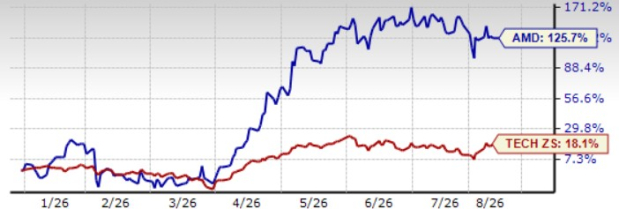
AMD shares have jumped 125.7% year to date, outperforming the broader Zacks Computer and Technology sector’s return of 18.1%.
AMD Stock’s Price Performance
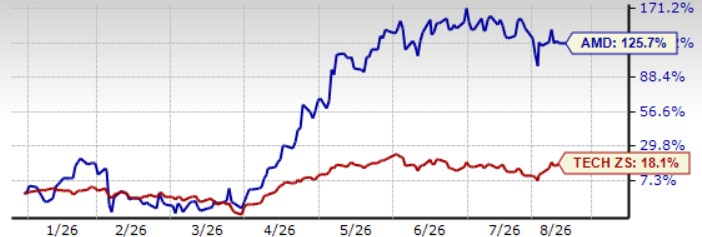
Image Source: Zacks Investment Research
AMD stock is overvalued, with a forward 12-month price/sales of 11.37X compared with the broader sector’s 6.58X. AMD has a Value Score of F.
AMD Valuation
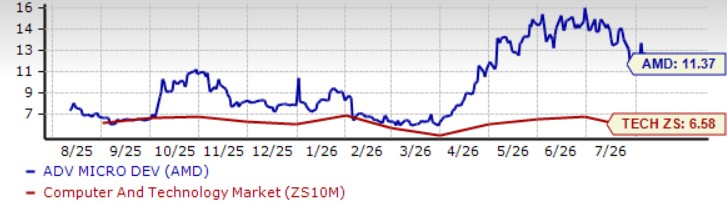
Image Source: Zacks Investment Research
The Zacks Consensus Estimate for third-quarter 2026 earnings is pegged at $1.87 per share, up a couple of cents over the past 30 days, suggesting 55.83% year-over-year growth.
Advanced Micro Devices, Inc. Price and Consensus

Advanced Micro Devices, Inc. price-consensus-chart | Advanced Micro Devices, Inc. Quote
AMD currently sports a Zacks Rank #1 (Strong Buy). You can see the complete list of today’s Zacks #1 Rank stocks here.
Zacks’ Research Chief Names “Stock Most Likely to Double”
Our team of experts has just released the 5 stocks with the greatest probability of gaining +100% or more in the coming months. Of those 5, Director of Research Sheraz Mian highlights the one stock set to climb highest.
This top pick is a little-known satellite-based communications firm. Space is projected to become a trillion dollar industry, and this company’s customer base is growing fast. Analysts have forecasted a major revenue breakout in 2025. Of course, all our elite picks aren’t winners but this one could far surpass earlier Zacks’ Stocks Set to Double like Hims & Hers Health, which shot up +209%.
Free: See Our Top Stock And 4 Runners Up
Advanced Micro Devices, Inc. (AMD) : Free Stock Analysis Report
NVIDIA Corporation (NVDA) : Free Stock Analysis Report
Alphabet Inc. (GOOGL) : Free Stock Analysis Report
This article originally published on Zacks Investment Research (zacks.com).
5 Stocks Our Experts Predict Could Double In the Next Year
By submitting your email, you'll also get a free pivot & flow membership. A free daily market overview. You can unsubscribe at any time.