Key Points
Nvidia’s latest quarterly results clearly suggest that its phenomenal growth rate is here to stay.
The semiconductor bellwether’s fiscal 2028 growth estimate exceeds analysts’ expectations, suggesting that its actual growth could be much stronger.
Nvidia stock has multibagger potential, even though it is currently the world’s largest company.
- 10 stocks we like better than Nvidia ›
An investment of $1,000 made in Nvidia (NASDAQ:NVDA) stock three years ago is now worth an impressive $4,500, according to YCharts. This impressive multibagger performance has been fueled by the company’s dominant position in the artificial intelligence (AI) chip market, driving remarkable growth in revenue and earnings over this period.
Nvidia is now the world’s largest company by market cap. Investors may therefore be wondering whether this stock can deliver further upside following its stunning run over the past three years. The good news is that Nvidia’s growth rate isn’t going to slow down any time soon, as evident from its latest quarterly report.
Missed Nvidia in 2009? This Rare Signal Is Flashing Again. In 2009, a “Double Down” signal flashed for a little-known chipmaker called Nvidia. For the first time in years, that same “Total Conviction” signal is flashing for a company 1/100th the size of Nvidia. Continue »
Let’s take a closer look at Nvidia’s catalysts and its growth potential for the next three years to check how much a $1,000 investment in this AI stock could be in 2029.

Image source: The Motley Fool.
Nvidia’s guidance points toward outstanding earnings growth for the next three years
When Nvidia released its fiscal 2027 second-quarter results (for the three months ended July 26) on Aug. 26, it reported a year-over-year increase of 120% in non-GAAP earnings per share to $2.22. The strong bottom-line growth was driven by a 106% year-over-year jump in revenue, along with an improvement of 2.5 percentage points in Nvidia’s non-GAAP gross margin.
Importantly, Nvidia management is confident of sustaining healthy gross margin levels despite higher component costs. For instance, the company estimates a non-GAAP gross margin of 74% in the current quarter, followed by a dip to 71% to 72% in fiscal Q4. The chip designer estimates that its gross margin will settle in the 72%-73% range next year, driven by price increases to offset higher component costs.
Nvidia’s ability to sustain its margin profile, along with incremental spending on AI data center infrastructure, should ensure that its earnings per share continue to improve at a nice clip. After all, Nvidia sees capital spending by the top five U.S. hyperscalers increasing to $1.3 trillion in 2027, up from an estimated $800 billion in 2026.
Moreover, this estimate doesn’t include the capital expenses incurred by neocloud providers and pure-play AI companies. Not surprisingly, market research provider Dell’Oro Group estimates that overall data center capex could exceed $3 trillion by 2030 to support the growing demand for AI workloads in the cloud.
So, data center capex could increase at a compound annual rate of 39% between 2026 and 2030. Another key point worth noting is that semiconductors reportedly account for 54% of the money spent on data centers, according to the Center for Strategic & International Studies. Nvidia controls an estimated 80% of the AI chip market. Also, it is expanding its presence in this space by entering lucrative areas such as server central processing units (CPUs).
So, it is easy to see why analysts have become more bullish on its revenue growth prospects for the next three fiscal years.
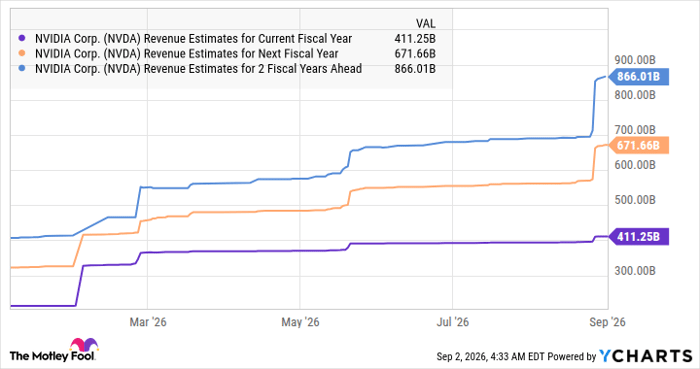
NVDA Revenue Estimates for Current Fiscal Year data by YCharts
Importantly, Nvidia’s healthy market share also gives it solid pricing power, putting the company in a strong position to pass higher component costs on to customers. That probably explains why management noted on the latestearnings callthat it will implement price increases starting in the first quarter of fiscal 2028.
In all, a combination of robust revenue growth and stable margins should eventually allow Nvidia to deliver strong earnings growth over the long run.
Nvidia stock still has multibagger potential
Nvidia’s earnings per share in fiscal 2027 (which ends in January 2027) could increase by 95% to $9.29. Importantly, the earnings per share estimates for the next couple of years have jumped significantly.

NVDA EPS Estimates for Current Fiscal Year data by YCharts
Analysts now expect Nvidia’s earnings to increase by 65% in fiscal 2028, followed by a 32% increase in fiscal 2029 (which will end in January 2029). Of course, Nvidia’s growth could exceed expectations, especially considering that it anticipates a 70% increase in revenue in fiscal 2028. But even if Nvidia’s earnings per share reach $20.45 in fiscal 2029 and it trades at 34 times earnings at that time (in line with the tech-focused Nasdaq-100 index’s average earnings multiple), its stock price could jump to $695.
That’s just over 3x Nvidia’s current stock price. So, a $1,000 investment in Nvidia stock could be worth more than $3,000 by 2029, which is why investors can consider buying it hand over fist following its latest quarterly report.
Should you buy stock in Nvidia right now?
Before you buy stock in Nvidia, consider this:
The Motley Fool Stock Advisor analyst team just identified what they believe are the 10 best stocks for investors to buy now… and Nvidia wasn’t one of them. The 10 stocks that made the cut could produce monster returns in the coming years.
Consider when Netflix made this list on December 17, 2004… if you invested $1,000 at the time of our recommendation, you’d have $445,833!* Or when Nvidia made this list on April 15, 2005… if you invested $1,000 at the time of our recommendation, you’d have $1,402,153!*
Now, it’s worth noting Stock Advisor’s total average return is 993% — a market-crushing outperformance compared to 214% for the S&P 500. Don’t miss the latest top 10 list, available with Stock Advisor, and join an investing community built by individual investors for individual investors.
*Stock Advisor returns as of September 4, 2026.
Harsh Chauhan has no position in any of the stocks mentioned. The Motley Fool has positions in and recommends Nvidia. The Motley Fool has a disclosure policy.
5 Stocks Our Experts Predict Could Double In the Next Year
By submitting your email, you'll also get a free pivot & flow membership. A free daily market overview. You can unsubscribe at any time.