Oracle ORCL and Microsoft MSFT are established enterprise technology providers, both embedding artificial intelligence (AI) into cloud and productivity platforms. Oracle’s database franchise anchors Oracle Cloud Infrastructure, while Microsoft’s Azure and Copilot ecosystem builds on its enterprise computing dominance.
Both companies recently posted record fourth-quarter fiscal 2026 results, disclosed aggressive new AI capex plans and issued bullish forward guidance tied to cloud and AI demand.
Let’s delve deep and closely compare the fundamentals of the two stocks to determine which one is a better investment now.
The Case for ORCL Stock
Oracle’s fourth-quarter fiscal 2026 results underscored the depth of enterprise AI demand flowing into Oracle Cloud Infrastructure. Cloud infrastructure revenues surged 93% in the quarter, pushing total fiscal 2026 revenues to a record $67.4 billion, up 17%, with cloud revenues climbing 39% to $34 billion. Non-GAAP operating income reached a record $28.9 billion, up 16%, while operating cash flow hit a record $32 billion, up 54%. The standout metric remains Remaining Performance Obligations, which ended the year at $638 billion, up 363% year over year, reflecting large, committed AI infrastructure contracts that provide multi-year revenue visibility.
Management’s guidance reinforces this momentum: fiscal 2027 revenues are projected at $90 billion, up 34% in constant currency, with non-GAAP EPS of $8.05. Oracle’s long-term outlook calls for a 31% revenue CAGR and 28% non-GAAP EPS CAGR through fiscal 2030. Recent moves extend Oracle’s AI ecosystem, including an August 2026 partnership with Quantinuum to bring hybrid quantum-AI computing to OCI, day-zero availability of NVIDIA’s Nemotron 3.5 Lightning model in OCI Enterprise AI and expanded imported-model support such as GLM 5.2, broadening OCI’s agentic AI toolkit.
Oracle plans to raise roughly $40 billion in debt and equity in fiscal 2027, including an already announced $20 billion at-the-market equity program, funding continued capacity expansion without near-term reliance on additional debt financing this calendar year. With committed customer prepayments and improving infrastructure margins as scale builds, Oracle’s growth runway appears well underpinned by contracted demand rather than speculative capacity, giving investors confidence in its AI infrastructure buildout.
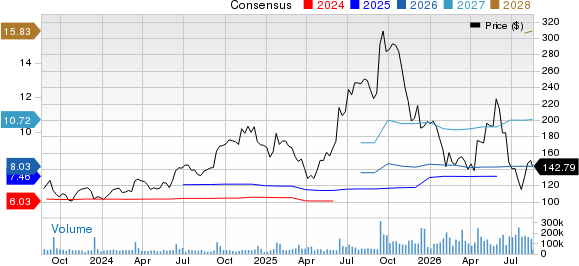
The Zacks Consensus Estimate for fiscal 2027 earnings is pegged at $8.03, suggesting 5.24% growth year over year.
Oracle Corporation Price and Consensus

Oracle Corporation price-consensus-chart | Oracle Corporation Quote
The Case for MSFT Stock
Microsoft closed fiscal 2026 with fourth-quarter revenues of $90 billion, up 18%, and Azure growth of 43%, pushing Azure past $100 billion in annual revenues for the first time. Full-year revenues reached $331.8 billion, up 18%, with operating income of $155.2 billion, up 21%. Commercial RPO climbed to $678 billion, up 84% year over year, and paid Microsoft 365 Copilot seats surpassed 30 million, with net additions more than doubling sequentially and enterprise deployments of 50,000-plus seats scaling more than sevenfold year over year.
Guidance points to continued strength, with first-quarter fiscal 2027 Azure growth guided at 45% in constant currency and total revenues guided between $89.85 billion and $90.95 billion. However, capital intensity is rising sharply: fiscal 2027 capital-expenditure guidance sits at $255 billion to $260 billion, well above the fiscal 2026 levels, even as Microsoft extended data center useful life to 25 years and shifted certain leases to operating treatment to ease depreciation pressure. More Personal Computing revenues declined 4% on softer PC and Xbox hardware demand, and fourth-quarter results included a discrete $3.2 billion gain tied to its Anthropic investment, complicating like-for-like year-over-year comparisons across recent quarters.
Recent Copilot updates, including richer visual answers, expanded connector crawling, and new AI consumption-tracking dashboards for Cowork and WorkIQ services, show steady product iteration heading into fiscal 2027. Microsoft’s expanding reliance on OpenAI as a Copilot subprocessor, alongside evolving EU data-residency disclosures, also warrants continued monitoring, as does the margin trade-off tied to an accelerating, capital-intensive infrastructure buildout entering fiscal 2027.
The Zacks Consensus Estimate for MSFT’s fiscal 2027 earnings is pegged at $19.59 per share. The estimate indicates 9.14% year-over-year growth.
Microsoft Corporation Price and Consensus

Microsoft Corporation price-consensus-chart | Microsoft Corporation Quote
Valuation and Price Performance Comparison
Oracle trades at a discounted forward 12-month P/E of 16.57X versus Microsoft’s steeper 23.97X, giving investors direct access to Oracle’s AI infrastructure growth at a comparatively reasonable multiple relative to its guided long-term expansion.
ORCL vs. MSFT P/E Ratio
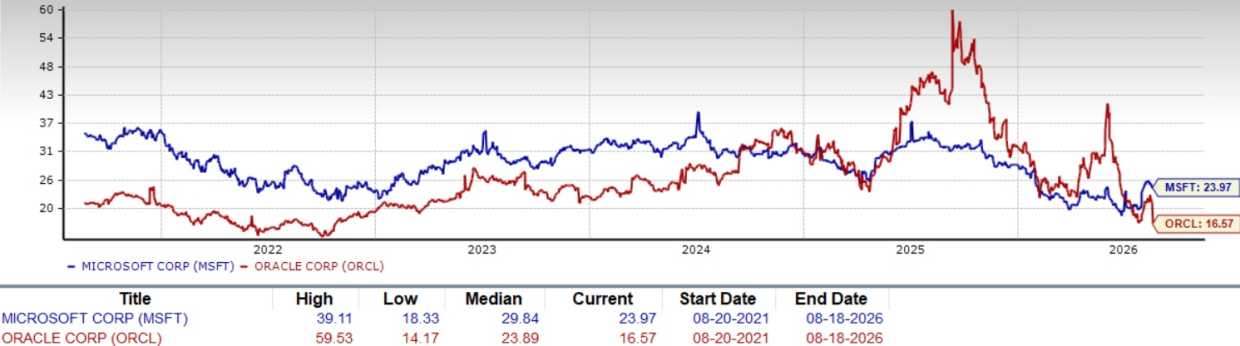
Image Source: Zacks Investment Research
On price performance, Oracle shares have plunged 26.7% year to date, while Microsoft shares have lost 0.4%, both underperforming the Zacks Computer and Technology sector’s 18.9% growth. Oracle’s sharper pullback, set against record RPO growth and accelerating guidance, arguably presents investors a more attractive entry point for discounted exposure to enterprise AI infrastructure demand, especially relative to Microsoft’s comparatively premium valuation and more modest year-to-date decline.
ORCL Underperforms MSFT, Sector YTD
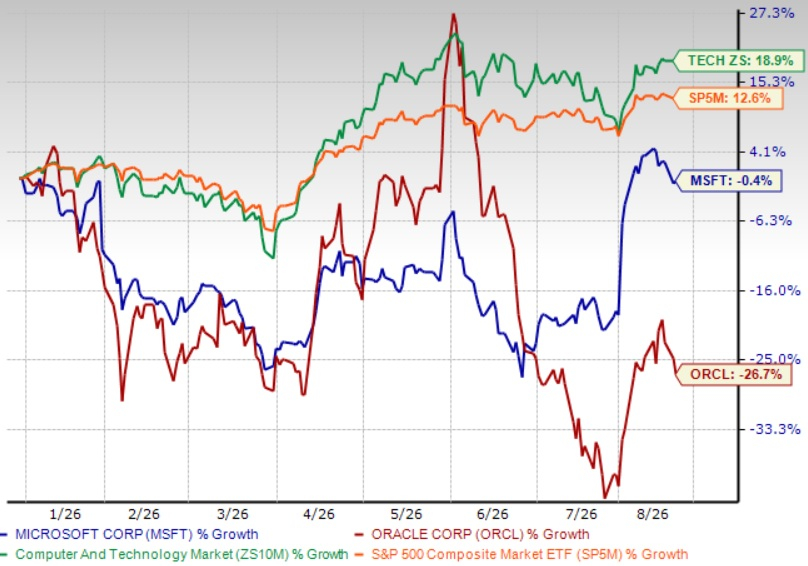
Image Source: Zacks Investment Research
Conclusion
Oracle’s record RPO growth, disciplined funding plan, expanding AI infrastructure partnerships and discounted valuation give it a clear fundamental edge over Microsoft, whose growth remains strong but is tempered by decelerating consumer segments, rising capital intensity and a steeper valuation. Oracle’s steeper year-to-date decline appears disconnected from its accelerating contracted demand, offering a more attractive entry point relative to its own guidance and growth trajectory. Given this combination of stronger relative value, comparable AI-driven growth visibility and record backlog momentum, investors may consider buying ORCL stock now while holding existing MSFT positions and awaiting a more attractive entry point ahead. ORCL currently carries a Zacks Rank #2 (Buy), whereas MSFT has a Zacks Rank #3 (Hold). You can see the complete list of today’s Zacks #1 Rank (Strong Buy) stocks here.
Zacks’ Research Chief Names “Stock Most Likely to Double”
Our team of experts has just released the 5 stocks with the greatest probability of gaining +100% or more in the coming months. Of those 5, Director of Research Sheraz Mian highlights the one stock set to climb highest.
This top pick is a little-known satellite-based communications firm. Space is projected to become a trillion dollar industry, and this company’s customer base is growing fast. Analysts have forecasted a major revenue breakout in 2025. Of course, all our elite picks aren’t winners but this one could far surpass earlier Zacks’ Stocks Set to Double like Hims & Hers Health, which shot up +209%.
Free: See Our Top Stock And 4 Runners Up
Microsoft Corporation (MSFT) : Free Stock Analysis Report
Oracle Corporation (ORCL) : Free Stock Analysis Report
This article originally published on Zacks Investment Research (zacks.com).
5 Stocks Our Experts Predict Could Double In the Next Year
By submitting your email, you'll also get a free pivot & flow membership. A free daily market overview. You can unsubscribe at any time.