Key Points
Microsoft stock closed at $36.35 on Feb. 4, 2014, the day Satya Nadella became CEO.
A $10,000 investment on that day has grown to about $124,000, or about $150,000 with dividends reinvested.
Azure revenue surpassed $100 billion in fiscal 2026 for the first time.
- 10 stocks we like better than Microsoft ›
Microsoft (NASDAQ: MSFT) had itself a day on Thursday. Shares of the software giant jumped 15.5% to $451.10 following its fiscal fourth-quarter report. It was the stock’s biggest one-day percentage gain since 2008, and it added about $450 billion of market value in a single session.
The report earned the reaction. The quarter (ended June 30) delivered $90.0 billion of revenue, up 18% year over year. And the star was the cloud. “Azure and other cloud services” revenue climbed 43%, an acceleration from the fiscal third quarter’s 40%.
Missed Nvidia in 2009? This Rare Signal Is Flashing Again. In 2009, a “Double Down” signal flashed for a little-known chipmaker called Nvidia. For the first time in years, that same “Total Conviction” signal is flashing for a company 1/100th the size of Nvidia. Continue »
But one historic Thursday is a strange way to measure this company. To me, the better measurement starts on Feb. 4, 2014, the day Satya Nadella took over as CEO.
So, after a week like this one, what would a $10,000 investment made on Nadella’s first day be worth now?
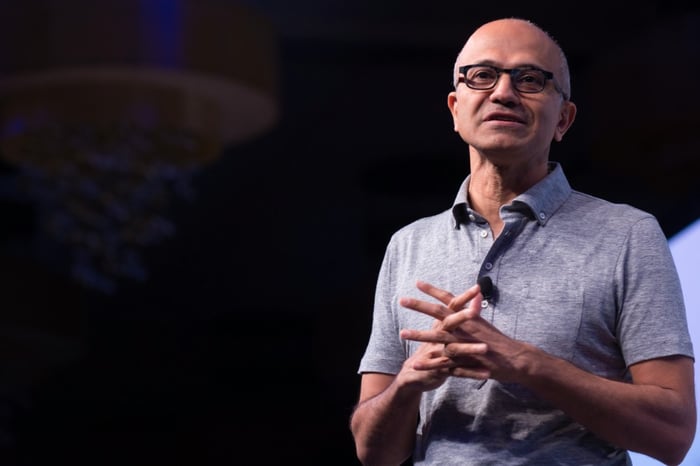
Image source: Microsoft Corporation.
From $36.35 to $451.10
Microsoft stock closed at $36.35 on the day Nadella became CEO. At Thursday’s close of $451.10, the shares have grown to about 12 times their starting price. That alone turns a $10,000 investment into about $124,000.
And the real result is better. Microsoft has paid a dividend every quarter of Nadella’s tenure, raising its quarterly payout from $0.28 per share when he arrived to $0.91 today (a yield of about 0.8% at the current price). Reinvest each of those payments along the way, and the original $10,000 grows to about $150,000.
For perspective, the S&P 500 roughly quadrupled over the same stretch. The same $10,000 in an index fund, dividends reinvested, would be worth about $52,000. Microsoft delivered nearly three times the market’s result — while being one of the largest companies in the world the entire time.
What did shareholders get for their patience? A different company. In fiscal 2014, the year Nadella arrived, Microsoft’s revenue was $86.8 billion, and Windows still defined the business. In fiscal 2026, which ended in June, revenue was $331.8 billion, with operating income climbing 21% year over year.
Even more telling, Azure (the cloud computing platform Nadella bet the company on) crossed $100 billion of annual revenue for the first time. The cloud business alone now brings in more revenue in a year than the entire company did when he started.
“Azure revenue surpassed $100 billion for the first time, and Microsoft 365 Copilot reached over 30 million paid seats,” Nadella said in the company’s fourth-quarter earnings release.
Would I buy Microsoft today?
A backtest can’t be repeated, though. Anyone buying now is buying the next stretch, and Wednesday’s report offers a fair amount to go on.
For the full fiscal year, revenue rose 18% while earnings per share climbed 32% year over year to $17.95. Full-year net income grew 31%, too. And the fourth quarter closed the year strong, with net income of $35.8 billion coming in 31% higher than a year earlier.
Also worth noting: management guided for Azure growth of about 45% in constant currency in the current quarter, which would be an acceleration from an already accelerating pace. Azure grew 40% in fiscal Q3 and 43% in fiscal Q4. And Microsoft’s commercial remaining performance obligations (contracted work customers have signed up for but the company hasn’t yet delivered) reached $678 billion, up 84% year over year.
Then there’s the price. At $451.10, the price tag works out to about 25 times earnings. Set that against 18% revenue growth and earnings per share rising 32%, and the multiple arguably looks reasonable. It doesn’t require the next 12 years to look like the last 12, either. Good thing, because they almost certainly won’t. A company already worth $3.4 trillion can’t repeat a 12-fold run with the same ease.
Of course, the risks have grown with the company. Microsoft is spending heavily on data centers, and the more it builds, the more its future earnings depend on cloud demand outpacing capacity. If Azure’s growth cooled sharply while that spending kept climbing, the stock could take a hit.
Still, the lesson of the Nadella era isn’t that Microsoft got lucky. It’s that a dominant business, repositioned around the right opportunity and, given time, can compound in a way that makes even a record Thursday look small. As for me, I’d still buy Microsoft at this price. Sure, the next 12 years likely won’t look as good as the last, but I think they’ll look decent.
Should you buy stock in Microsoft right now?
Before you buy stock in Microsoft, consider this:
The Motley Fool Stock Advisor analyst team just identified what they believe are the 10 best stocks for investors to buy now… and Microsoft wasn’t one of them. The 10 stocks that made the cut could produce monster returns in the coming years.
Consider when Netflix made this list on December 17, 2004… if you invested $1,000 at the time of our recommendation, you’d have $394,601!* Or when Nvidia made this list on April 15, 2005… if you invested $1,000 at the time of our recommendation, you’d have $1,197,093!*
Now, it’s worth noting Stock Advisor’s total average return is 895% — a market-crushing outperformance compared to 206% for the S&P 500. Don’t miss the latest top 10 list, available with Stock Advisor, and join an investing community built by individual investors for individual investors.
*Stock Advisor returns as of August 1, 2026.
Daniel Sparks and his clients do not have positions in any of the stocks mentioned. The Motley Fool has positions in and recommends Microsoft. The Motley Fool has a disclosure policy.
5 Stocks Our Experts Predict Could Double In the Next Year
By submitting your email, you'll also get a free pivot & flow membership. A free daily market overview. You can unsubscribe at any time.