Get the latest insights on Bitcoin, Ether and altcoins, along with a round-up of key cryptocurrencymarket news
Here’s a quick recap of the crypto landscape for Friday (July 31) as of 10:00 p.m. UTC.
Bitcoin price update
Bitcoin (BTC) was priced at US$62,949.41, down by 2.7 percent over the past 24 hours.
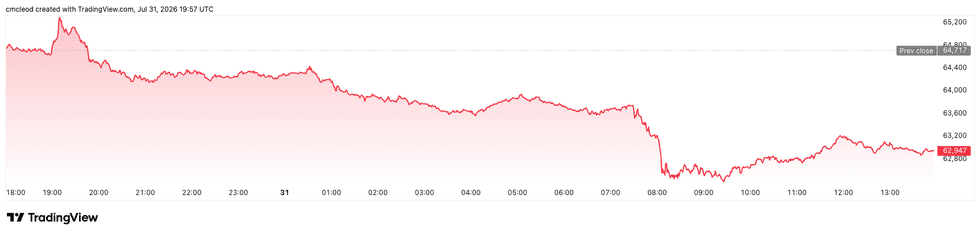
Chart via TradingView.
Bitcoin price performance, July 31, 2026.
In an email to The Investing News Network (INN), Yield Basis and Curve Finance founder Michael Egorov said macro uncertainty, often seen as a headwind, is actually a tailwind for liquidity providers, as it fuels trading activity and fee generation. While higher rates can boost tokenized Treasury products, purely on-chain yield strategies can remain competitive or even strengthen if rates fall.
“In that sense, I believe that DeFi should embrace uncertainty rather than fear it, because it is exactly these periods that create opportunities,” he wrote.
At the same time, regulatory uncertainty continues to shape institutional participation. WisdomTree’s Ryan Louvar emphasizes that while digital asset adoption is advancing, the lack of durable US legislation like the stalled CLARITY Act risks undermining long-term competitiveness. Institutional capital may not wait indefinitely for regulatory clarity, particularly as global frameworks evolve.
“The US still has a crucial opportunity to establish a framework that preserves investor protections while modernizing the rails on which our capital markets operate. Institutional adoption will not wait for Washington indefinitely, and neither will global competition,” he told INN.
In the near term, however, market structure remains the key constraint. Bitget Wallet analyst Lacie Zhang notes that Bitcoin is likely to stay range-bound without sustained ETF inflows or a meaningful liquidity catalyst such as declining real yields. While pockets of speculative activity may drive sharp rallies in smaller tokens, these moves reflect fragmented capital rotation rather than a broad-based altcoin cycle.
Ether and altcoin price update
- Ether (ETH) was priced at US$1,866.49, trading 2.6 percent lower over the last 24 hours.
- XRP (XRP) was priced at US$1.06, trading 2.4 percent lower over the past 24 hours.
- Solana (SOL) was trading at US$73.11, trading 2.3 percent lower over the past 24 hours.
Today’s crypto news to know
Read on for a round-up of the biggest cryptomarket news
- Coinbase reports third consecutive quarterly loss
- Strategy posts US$8.22 billion second quarter loss
- CLARITY Act exposes crypto system to financial crime, former prosecutor warns
Coinkite Coldcard vulnerability results in US$38 million BTC theft
A critical firmware vulnerability in Coinkite’s Coldcard Bitcoin hardware wallets has led to the theft of 594 BTC worth roughly US$38 million from around 500 wallets in a 25-minute sweep between 01:10 and 01:56 UTC on Thursday night (July 30).
The attacker consolidated most of the stolen tokens into a single address that has not moved since.
The attack happened when a bug in Coldcard’s firmware broke the way private keys were created. Normally, these keys are built using random data, but in this case, the bug caused the device to use far less randomness than it should have, making the resulting seed phrases much easier to crack.
Attackers could then use powerful computers to guess the missing pieces offline and steal the funds without ever needing to touch the wallet itself.
Coinkite released emergency firmware updates but warned that any seed generated on a Coldcard Mk3 running firmware 4.0.1 through 5.0.3 may be at risk and urged users to migrate funds off those wallets immediately.
Project Agorá test results
Participants from 28 commercial banks including, JPMorgan (NYSE:JPM), Citigroup (NYSE:C), UBS Group (NYSE:UBS), Deutsche Bank (NYSE:DB), Standard Chartered Bank (LSE:STAN,OTCPL:SCBFF) and Lloyds Banking Group, as well as five central banks (the Bank of England, Bank of France, Bank of Japan, Bank of Korea and Swiss National Bank) ran a live, real‑money test of tokenized wholesale money for cross‑border payments, coordinated by the Bank for International Settlements (BIS) under Project Agorá.
Roughly US$1 million in real value was settled across 17 transactions
Assets tokenized included central bank reserves and commercial bank deposits. The pilot did not use public cryptocurrencies or private stablecoins. Rather, all transactions ran on a single shared distributed ledger built for Project Agorá, where six currencies – USD, EUR, GBP, JPY, CHF and KRW – were represented as a programmable token backed by real reserves or deposits.
Average time from payment instruction to final settlement was about 80 seconds, even though the prototype was not yet integrated with banks’ legacy payment systems.
A parallel legal analysis concluded that settlement finality is viable under the laws of the seven jurisdictions involved, which include the Fed and ECB in earlier design work.
BIS says the next phase runs through Q4 2026. Definitive technical specifications are expected in Q1 2027.
Circle granted New York Trust Charter
Circle Internet Group (NYSE:CRCL) has received a limited-purpose trust charter from the New York Department of Financial Services, according to a Friday press release, placing Circle’s USDC stablecoin issuance under NYDFS supervision and fiduciary standards under New York Banking Law.
Circle New York Trust cannot take customer deposits or make loans like a traditional bank; instead, it can hold digital assets for customers and act in a fiduciary capacity.
Circle CEO Jeremy Allaire called the New York trust charter a “longstanding objective” and a key step in strengthening the regulatory foundation behind USDC.
Coinbase reports third consecutive quarterly loss
Coinbase Global (NASDAQ:COIN) reported a second-quarter net loss of US$359 million, or US$1.36 per share, missing analyst expectations of a US$0.44 decline.
Net revenue fell 17 percent from the previous year to US$1.15 billion as muted crypto trading activity dragged transaction revenue down 22 percent to US$600 million. The performance marks the exchange’s third consecutive quarterly loss as Bitcoin dropped over 27 percent in 2026.
Coinbase stock fell over 10 percent following the earnings release, bringing its year-to-date decline past 32 percent. Subscription and services revenue provided a partial buffer, generating US$555 million to account for 48 percent of total quarterly revenue.
Despite soft trading volumes, Coinbase expanded its crypto trading market share to a record 10.3 percent. The company continues to diversify beyond spot Bitcoin trading by expanding into retail derivatives and perpetual crypto futures alongside prediction market partner Kalshi.
Strategy posts US$8.22 billion second quarter loss
Strategy (NASDAQ:MSTR) posted an US$8.22 billion net loss for the second quarter of 2026, swinging from a US$10.02 billion net profit in the year-ago period.
An US$8.32 billion unrealized loss on digital asset holdings under fair-value accounting rules drove the quarterly deficit.
Strategy held 846,000 Bitcoin as of June 30, with an acquisition cost of US$63.9 billion against a late-July market value of US$54.8 billion. Second-quarter revenue rose 6.9 percent year over year to US$122.4 million, yielding US$81.6 million in gross profit.
To reinforce investor confidence, Strategy accumulated a US$3.75 billion cash reserve, which covers preferred dividend payments and interest obligations for over two years. The firm broke from its traditional buy-and-hold approach by liquidating a portion of its Bitcoin to raise US$218.4 million for preferred dividend payouts.
Executive Chairman Michael Saylor stated that the company will continue expanding its business model to establish Digital Credit as a new asset class.
CLARITY Act exposes crypto system to financial crime, former prosecutor warns
Former Maryland deputy state’s attorney Thomas J. Fleckenstein publicly warned US Senators Angela Alsobrooks and Chris Van Hollen that the proposed CLARITY Act contains critical enforcement gaps.
In a commentary published by the Baltimore Sun, Fleckenstein stated that the current draft fails to apply Bank Secrecy Act and Anti-Money Laundering standards to crypto firms at traditional banking levels.
The bill includes a controversial DeFi exemption that frees decentralized crypto platforms from mandatory registration and federal oversight. Major law enforcement organizations, including the National Sheriffs’ Association and the International Association of Chiefs of Police, warned that the exemption hampers illicit fund tracking.
FBI data indicates consumers reportedUS $9.3 billion in crypto-related financial crime losses during 2024 alone.
Fleckenstein argued that unregulated digital assets expose consumers to rampant hacks while threatening national security. He urged Senate leaders to mandate strict banking-level compliance rules across all crypto platforms before allowing the legislation to move forward.
Don’t forget to follow us @INN_Technology for real-time news updates!
Securities Disclosure: I, Meagen Seatter, hold no direct investment interest in any company mentioned in this article.
Securities Disclosure: I, Giann Liguid, hold no direct investment interest in any company mentioned in this article.
5 Stocks Our Experts Predict Could Double In the Next Year
By submitting your email, you'll also get a free pivot & flow membership. A free daily market overview. You can unsubscribe at any time.