As artificial intelligence and cloud infrastructure reshape global technology spending, Cisco (NASDAQ:) remains a core provider of the networks and security systems that keep digital economies running. The company is balancing steady enterprise demand with rising AI-driven investment, while continuing its shift toward higher recurring software revenue. With evolving competitive dynamics and margin considerations in focus, Cisco’s performance in 2026 will depend on growth execution, cost discipline, and its ability to convert AI momentum into sustainable profitability.
Cisco: Powering the Digital Backbone of the AI Era
Cisco Systems, Inc. is a global technology leader specializing in networking, cybersecurity, and collaboration solutions. Founded in 1984 and headquartered in San Jose, California, Cisco builds the infrastructure that powers the internet, enterprise networks, and data centers worldwide. The company combines hardware, software, and recurring services to deliver secure, AI-ready connectivity for businesses and governments. With a strong installed base, expanding cybersecurity portfolio, and growing subscription revenue, Cisco is widely viewed as a mature, cash-generative technology company focused on stability, innovation, and long-term digital infrastructure growth.
Cisco Earnings: AI Growth Lifts Revenue as Guidance Moves Higher
In its latest earnings report, reported revenue of approximately $15.3 billion, reflecting solid year-over-year growth driven by AI-related infrastructure demand and resilient enterprise spending. Adjusted earnings per share (EPS) also improved from the prior year and came in ahead of market expectations, supported by disciplined cost management and expanding software subscriptions. While gross margins faced some pressure due to product mix and component costs, management raised its full-year revenue outlook. Strong cash flow enabled continued dividends and share repurchases, reinforcing Cisco’s position as a stable, cash-generative technology leader.
Technical Outlook for CISCO
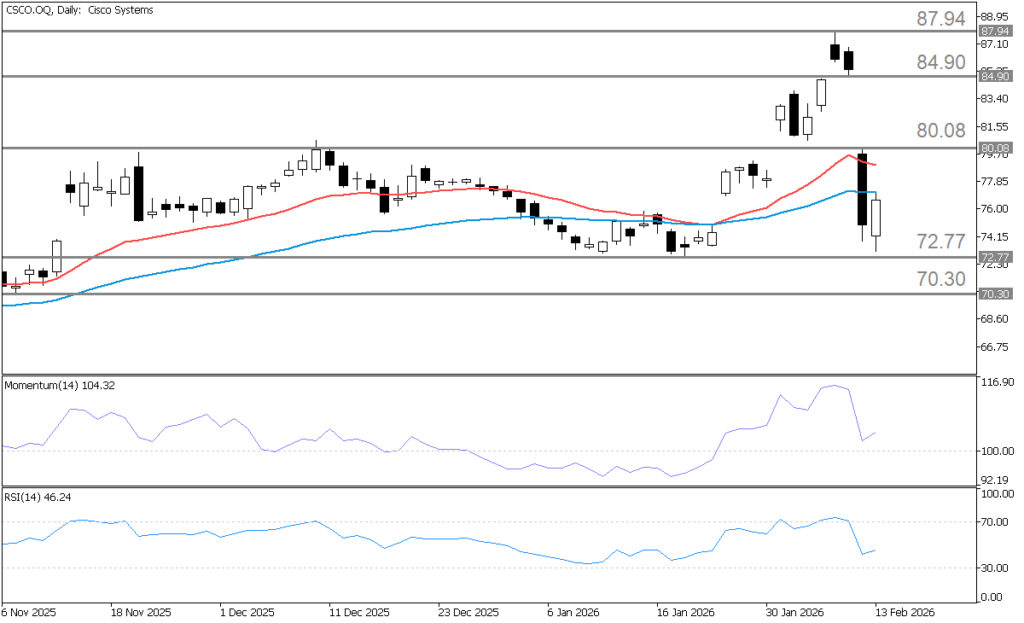
From a technical standpoint, Cisco Systems Inc. continues to exhibit a corrective broader structure, although recent price behavior points to tentative stabilization. The stock remains below both the 20- and 50-period exponential moving averages, whose flattening slopes suggest consolidation rather than a sustained directional move, consistent with a subdued Average Directional Index reading. Momentum indicators are mixed: the Momentum oscillator remains above 100, signaling underlying buying interest, while the Relative Strength Index stays below 50, indicating that sellers retain a slight near-term edge.
At the time of writing, the stock is trading near 76.59. Initial resistance is seen at 80.08, followed by 87.94 and 93.27. On the downside, support is located at 72.77; a break below this level could open the way toward 70.30. In a deeper corrective phase, the 60.60 region may act as a stronger structural support zone.
AI Demand Accelerates Cisco’s Growth Story
Demand for AI-related networking equipment is increasing quickly. In fiscal Q2 2026 (ended January 24, 2026), Cisco Systems Inc. reported revenue of $15.3 billion, up 10% compared to last year. The company also announced $2.1 billion in AI infrastructure orders from large cloud providers, a sharp increase from $1.3 billion in the previous quarter.
Management raised its full-year revenue forecast to $61.2–$61.7 billion and expects AI infrastructure revenue from major cloud customers to exceed $3 billion this year. In simple terms, sales momentum is improving — but investors will want to see profits remain strong as growth accelerates.
Margin Pressure and Competition: The Key Risks Facing Cisco
Cisco Systems Inc. faces a combination of market, financial, and competitive risks. Gross margins have been pressured by rising memory costs and component shortages, which have weighed on profitability and triggered stock volatility after earnings. Analysts continue to flag margin compression and cost competition as key near-term challenges. Ongoing supply chain constraints could further squeeze profits, even if revenue continues to grow. At the same time, Cisco operates in a highly competitive environment, facing rivals in networking, cloud, and cybersecurity. Fluctuating hardware demand, acquisition integration risks, and broader macroeconomic slowdowns also remain important potential headwinds.
Outlook 2026: Steady Growth Powered by AI Demand
In 2026, Cisco Systems Inc. is expected to deliver steady growth, supported by strong demand for AI-driven networking and data center infrastructure. The company has projected full-year revenue between $61.2 billion and $61.7 billion, with non-GAAP earnings per share of $4.13 to $4.17, signaling confidence in its order pipeline and enterprise spending. Ongoing AI infrastructure investment from major cloud providers should remain a key growth engine. However, higher component costs and competitive pricing may continue to pressure margins, meaning disciplined cost management and solid execution will be essential throughout the year.
5 Stocks Our Experts Predict Could Double In the Next Year
By submitting your email, you'll also get a free pivot & flow membership. A free daily market overview. You can unsubscribe at any time.