Key Points
Alphabet, Amazon, Meta, and Microsoft plan combined 2026 capital spending of more than $700 billion, most of it for AI infrastructure.
Apple spent $12.7 billion on capital expenditures in all of fiscal 2025.
Apple reports fiscal third-quarter results on Thursday, July 30.
- 10 stocks we like better than Apple ›
There is a spending contest underway in big tech, and Apple (NASDAQ: AAPL) has declined to enter it.
Alphabet lifted its 2026 capital spending plan to a top end of $205 billion last week. Amazon expects to invest about $200 billion this year, Microsoft has pointed to roughly $190 billion, and Meta Platforms plans as much as $145 billion. Together, that’s more than $700 billion in a single year, the great majority of it aimed at AI (artificial intelligence) infrastructure.
Missed Nvidia in 2009? This Rare Signal Is Flashing Again. In 2009, a “Double Down” signal flashed for a little-known chipmaker called Nvidia. For the first time in years, that same “Total Conviction” signal is flashing for a company 1/100th the size of Nvidia. Continue »
Apple’s capital expenditures in fiscal 2025 were $12.7 billion. In other words, the world’s largest consumer technology company is spending a fraction of what those four rivals will spend, combined, while they race to add AI computing capacity.
So is Apple’s restraint a capital-allocation edge, or a company in denial about what AI requires? With Apple’s fiscal third-quarter report due Thursday, July 30, it’s the right week to ask.
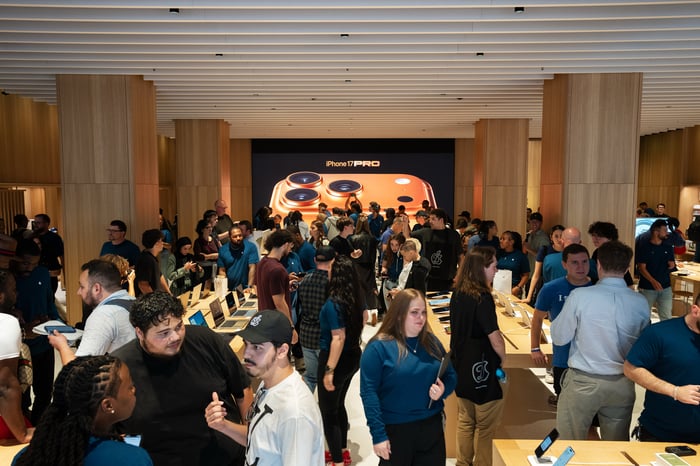
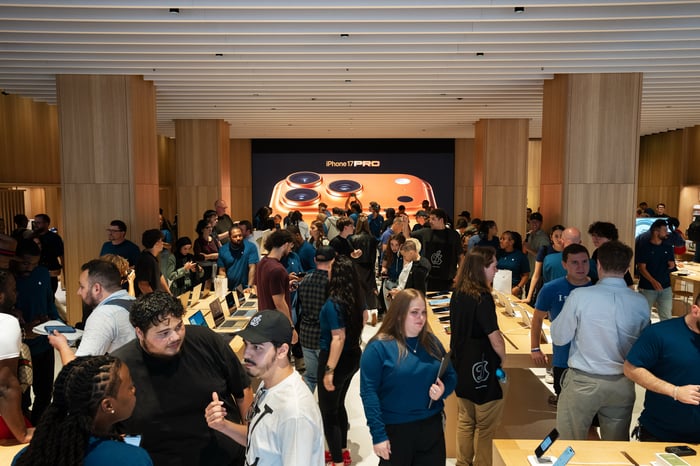
Image source: Apple.
Renting the build-out instead of funding it
Apple’s small budget isn’t an accident. It reflects a deliberate structure.
On the company’s fiscal first-quarterearnings call chief financial officer Kevan Parekh described a “hybrid” capital model, in which Apple leverages “a combination of first and third-party capacity.” In other words, Apple rents much of its computing power from cloud computing providers rather than building data centers itself, and when it does build for AI, it runs the servers on its own chips. That’s the basis of Private Cloud Compute, the infrastructure behind Apple Intelligence.
The structure means Apple can access third-party capacity without carrying the full construction bill. And if computing gets cheaper as all of that new supply comes online, renters could benefit first. Whether the access holds up at scale is the open question the next few years will answer.
Meanwhile, the strategy shows up where shareholders can see it. In the March quarter, Apple generated more than $28 billion in operating cash flow, a record for the period — and with capital spending under $3 billion, nearly all of it was free cash flow. Compare that with Alphabet, whose free cash flow was negative $5.9 billion in its most recent quarter, or Amazon, whose trailing-12-month free cash flow has fallen to $1.2 billion as its capital spending climbs.
Discipline is winning so far
Restraint would mean little if Apple’s business were stalling. It isn’t.
Fiscal second-quarter revenue rose 17% year over year to $111.2 billion, and earnings per share climbed 22% to $2.01. iPhone revenue hit $57 billion, a March-quarter record, up 22% year over year on demand for the iPhone 17 lineup. Services set an all-time revenue record. For perspective, Apple’s revenue grew about 6% in all of fiscal 2025 — so growth hasn’t just held up under the low-spend strategy, it has accelerated sharply.
That’s the case for discipline. The case for denial is worth taking seriously, too.
Apple’s approach partly depends on third-party capacity in a world where computing power is scarce — its rivals are spending those hundreds of billions precisely because demand keeps outrunning supply. If AI features become the deciding factor in phone and device purchases, and if delivering them requires more compute than Apple can rent or build quickly, the company could find itself paying up later at worse prices. That scenario can’t be ruled out, and it’s the main thing I’ll be listening for on the July 30 call. Apple’s own capital spending rose in fiscal 2025, with Parekh noting the company built out its Private Cloud Compute environment last year.
And the stock leaves little room for the strategy to fail. Shares trade near $333 as of this writing, just below their record high, at about 40 times earnings.
My verdict leans toward discipline. Apple is growing faster than it has in years and generating record cash, while its rivals bear the cost, and the risk, of their own infrastructure build-outs. If the strategy proves wrong, Apple has the cash flow to change course and pay up later. If it proves right, shareholders will never have paid for the detour.
Thursday’s report offers the next test. Another quarter of double-digit growth alongside a capital spending line that remains tiny next to its peers’ would be the strategy working, measurably. I own the stock, and nothing about the $700 billion around it makes me want to change that.
Should you buy stock in Apple right now?
Before you buy stock in Apple, consider this:
The Motley Fool Stock Advisor analyst team just identified what they believe are the 10 best stocks for investors to buy now… and Apple wasn’t one of them. The 10 stocks that made the cut could produce monster returns in the coming years.
Consider when Netflix made this list on December 17, 2004… if you invested $1,000 at the time of our recommendation, you’d have $377,990!* Or when Nvidia made this list on April 15, 2005… if you invested $1,000 at the time of our recommendation, you’d have $1,269,518!*
Now, it’s worth noting Stock Advisor’s total average return is 896% — a market-crushing outperformance compared to 206% for the S&P 500. Don’t miss the latest top 10 list, available with Stock Advisor, and join an investing community built by individual investors for individual investors.
*Stock Advisor returns as of July 27, 2026.
Daniel Sparks and his clients have positions in Apple. The Motley Fool has positions in and recommends Alphabet, Amazon, Apple, Meta Platforms, and Microsoft. The Motley Fool has a disclosure policy.
5 Stocks Our Experts Predict Could Double In the Next Year
By submitting your email, you'll also get a free pivot & flow membership. A free daily market overview. You can unsubscribe at any time.