Shares of Good Times Restaurants Inc. GTIM have gained 4.2% since the company reported its earnings for the quarter ended June 30, 2026, outperforming the S&P 500 Index’s 0.3% loss over the same period. Over the past month, however, the stock has gained 2.8%, compared with the S&P 500’s 2.3% rise.
Good Times Restaurants’ Earnings Snapshot
Good Times Restaurants reported third-quarter fiscal 2026 total revenues of $35.2 million, down 5% year over year from $37 million. Net income attributable to common shareholders increased 28.2% to $1.9 million from $1.5 million, while diluted earnings per share rose 28.6% to $0.18 from $0.14.
Bad Daddy’s restaurant sales fell 6.1% to $24.9 million from $26.5 million as same-store sales declined 2.3%. Good Times restaurant sales decreased 2.2% to $10.1 million from $10.4 million, although same-store sales increased 0.6%.
GTIM ended the quarter with 36 Bad Daddy’s and 25 company-owned Good Times restaurants, compared with 39 and 27, respectively, a year earlier.
GTIM’s Other Key Business Metrics
Adjusted EBITDA increased 18.5% to $2.5 million from $2.1 million in the prior-year quarter. Total restaurant-level operating profit, a non-GAAP measure, edged down 1.6% to $5.06 million from $5.14 million, though the margin improved to 14.5% from 13.9%.
Bad Daddy’s restaurant-level operating profit declined 5.7% to $3.6 million from $3.8 million, with its margin unchanged at 14.4%. Good Times restaurant-level operating profit increased 10.3% to $1.3 million from $1.2 million, while its margin expanded to 13% from 11.5%. Average weekly restaurant sales increased to $52,500 from $52,300 at Bad Daddy’s and to $30,100 from $29,500 at Good Times.
Cash stood at $3.6 million at quarter-end, while long-term debt was $0.3 million.
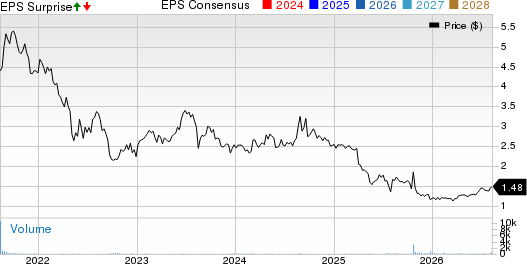
Good Times Restaurants Inc. Price, Consensus and EPS Surprise

Good Times Restaurants Inc. price-consensus-eps-surprise-chart | Good Times Restaurants Inc. Quote
Good Times Restaurants’ Management Commentary
CEO Ryan Zink highlighted improving trends at the Good Times brand following the systemwide June launch of the $2 Bambino promotion. Good Times recorded same-store sales growth in the mid-single digits during fiscal June, while sales, average check and transactions increased on a same-store basis in both fiscal June and July. Management is considering extending the promotional pricing beyond its initially planned summer run.
Bad Daddy’s continued to face softer sales. Management is testing value-oriented promotions and developing limited-time and permanent menu offerings. The Smashadia Burger launched in May became the brand’s best-selling individual limited-time burger to date, while additional monthly product launches are planned through the remainder of calendar 2026.
Factors Influencing GTIM’s Headline Numbers
Bad Daddy’s sales decline reflected fewer operating weeks stemming from a reduced restaurant count and lower customer traffic, partly offset by a 2.5% average menu-price increase. Food and packaging costs declined 30 basis points to 30.3% of sales, while labor costs declined 70 basis points to 33.6%. However, other operating costs increased 70 basis points to 15.3%.
At Good Times, a 1.7% average menu-price increase supported results. Food and packaging costs declined 30 basis points to 31.2%, and labor costs declined 120 basis points to 33%, reflecting greater labor efficiency despite higher wage rates. Occupancy costs increased 50 basis points to 9.1%, partly because of higher property taxes.
Income from operations increased 43.3% to $1.8 million from $1.2 million, aided by a $489,000 net gain on lease terminations and asset disposals compared with $4,000 a year earlier. Interest expense decreased 52.9% to $24,000 from $51,000.
Good Times Restaurants’ Guidance
Management expects overall company profitability in the fiscal fourth quarter to improve year over year, citing better cost management and stronger Good Times sales trends. It also expects full-year fiscal 2026 general and administrative costs to equal 6%-7% of revenues. Management currently does not plan additional Good Times menu-price increases during the balance of the year.
GTIM’s Other Developments
Good Times Restaurants paid off the balance on its revolving credit facility during the quarter, leaving approximately $300,000 of seller-financed debt associated with its June 2024 acquisition of a Good Times restaurant. GTIM also closed one Bad Daddy’s and one Good Times restaurant during the quarter.
GTIM recorded a $176,000 net gain related to the event and expects an insurance recovery, although the amount could not yet be reasonably estimated.
Beyond Nvidia: AI’s Second Wave Is Here
The AI revolution has already minted millionaires. But the stocks everyone knows about aren’t likely to keep delivering the biggest profits. AI’s second wave is moving from infrastructure to implementation and these companies are at the forefront of this transition, positioned to become what Amazon and Google were to the internet era.
Good Times Restaurants Inc. (GTIM) : Free Stock Analysis Report
This article originally published on Zacks Investment Research (zacks.com).
5 Stocks Our Experts Predict Could Double In the Next Year
By submitting your email, you'll also get a free pivot & flow membership. A free daily market overview. You can unsubscribe at any time.