Key Points
Tim Cook recently said that Apple is paying more for memory chips, and that this trend is expected to continue.
Micron is one of three major suppliers of DRAM and high-bandwidth memory.
Rising chip prices are a function of expanding AI workloads from the hyperscalers.
- 10 stocks we like better than Micron Technology ›
Micron Technology (NASDAQ: MU) designs and manufactures high-performance memory and storage solutions, with a particular focus on DRAM, NAND, and high bandwidth memory (HBM) that power everything from smartphones to the data centers driving artificial intelligence (AI) workloads.
Throughout 2026, Micron stock has soared on the back of unprecedented demand for memory chips as hyperscalers race to secure scarce supply. During the first half of the year, shares of Micron tripled before hitting an all-time high in late June. Then stock fell 26% from its peak and spent the last month recovering some of the lost ground.
Missed Nvidia in 2009? This Rare Signal Is Flashing Again. In 2009, a “Double Down” signal flashed for a little-known chipmaker called Nvidia. For the first time in years, that same “Total Conviction” signal is flashing for a company 1/100th the size of Nvidia. Continue »
Investors are now asking whether this pullback marks the end of Micron’s rally or a rare chance to buy the dip.
Why is Micron stock plummeting?
Micron’s decline has little to do with any sudden weakness in the AI memory market. Demand remains robust, with industry shortages expected to persist into 2027 and Micron’s own capacity sold out under multiyear supply agreements. Instead, the sell-off largely reflects profit-taking after an extraordinary run, combined with anxiety about the memory industry’s historically cyclical nature.
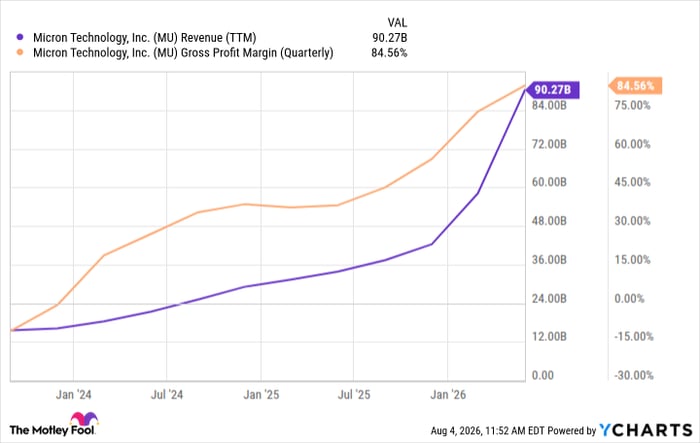
Investors fear that Chinese competitors could ease supply constraints or that the hyperscalers may moderate their capital expenditure (capex) budgets if returns on AI infrastructure investments disappoint. Although these concerns are understandable given past boom-and-bust memory chip cycles, I think they are overstated relative to current fundamentals. Pricing power remains intact, gross margins are climbing into the mid-80% range, and supply remains tight. In my eyes, Micron’s price slump looks more like a healthy digestion of gains rather than concrete evidence that the AI memory story is flawed.

MU Revenue (TTM) data by YCharts
What did Tim Cook just say about memory prices?
During Apple‘s recentearnings call Chief Executive Officer Tim Cook noted that the company was expecting to pay “significantly more” for memory in the June quarter than in March, and that is exactly what occurred. He added that memory costs will be “even higher” in the current quarter.

Apple CEO Tim Cook. Image source: Apple.
These remarks signal that pricing pressures are not a temporary spike but rather a sustained reality driven by demand outstripping supply. For Micron, which supplies both conventional DRAM and the specialized HBM for AI accelerators, Cook’s commentary is unambiguously positive.
Rising costs for major customers translate directly into higher average selling prices and expanded profit margins for producers. Far from signaling weakness, Cook’s candor underscores that the three dominant memory makers — Micron, Samsung, and SK Hynix — are operating in a seller’s market.
Should you buy the dip in Micron stock?
Given the persistent rise in memory prices that Cook highlighted, Micron has a realistic chance of surprising to the upside in its next earnings report. At a forward price-to-earnings (P/E) multiple of roughly 5.3, Micron stock trades at a fraction of the multiples commanded by other AI chip beneficiaries — even as revenue expands by triple-digit percentages year over year and is expected to continue climbing.
When elevated growth meets rising prices and a valuation that already reflects cyclical skepticism, Micron’s recent decline looks more like an opportunity than a warning. Investors willing to see past near-term volatility and focus on the multiyear memory shortage may view Micron’s current price as attractive rather than a reason to run for the hills.
Should you buy stock in Micron Technology right now?
Before you buy stock in Micron Technology, consider this:
The Motley Fool Stock Advisor analyst team just identified what they believe are the 10 best stocks for investors to buy now… and Micron Technology wasn’t one of them. The 10 stocks that made the cut could produce monster returns in the coming years.
Consider when Netflix made this list on December 17, 2004… if you invested $1,000 at the time of our recommendation, you’d have $396,758!* Or when Nvidia made this list on April 15, 2005… if you invested $1,000 at the time of our recommendation, you’d have $1,300,820!*
Now, it’s worth noting Stock Advisor’s total average return is 939% — a market-crushing outperformance compared to 211% for the S&P 500. Don’t miss the latest top 10 list, available with Stock Advisor, and join an investing community built by individual investors for individual investors.
*Stock Advisor returns as of August 6, 2026.
Adam Spatacco has no position in any of the stocks mentioned. The Motley Fool has positions in and recommends Apple and Micron Technology. The Motley Fool has a disclosure policy.
5 Stocks Our Experts Predict Could Double In the Next Year
By submitting your email, you'll also get a free pivot & flow membership. A free daily market overview. You can unsubscribe at any time.