Key Points
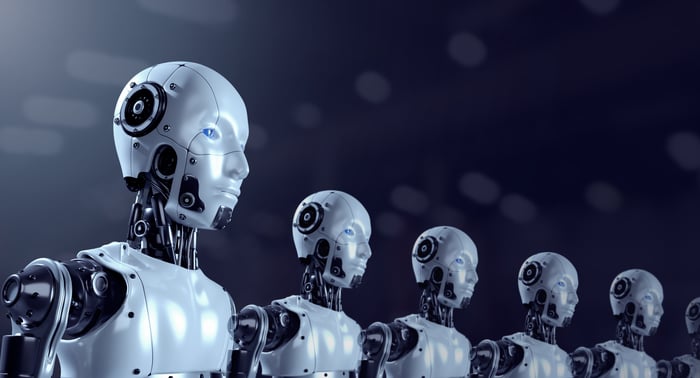
For years, humanoid robots were little more than technology demonstrations. They could walk, wave, and occasionally pick up a box, but commercial deployment remained years away. That’s changing.
Several of the world’s largest tech companies are now investing billions of dollars to commercialize humanoid robots for factories, warehouses, and eventually homes. Morgan Stanley estimates the global humanoid robot market could reach $5 trillion by 2050. That’s trillion, with a “T.”
Where to invest $1,000 right now? Our analyst team just revealed what they believe are the 10 best stocks to buy right now, when you join Stock Advisor. See the stocks »
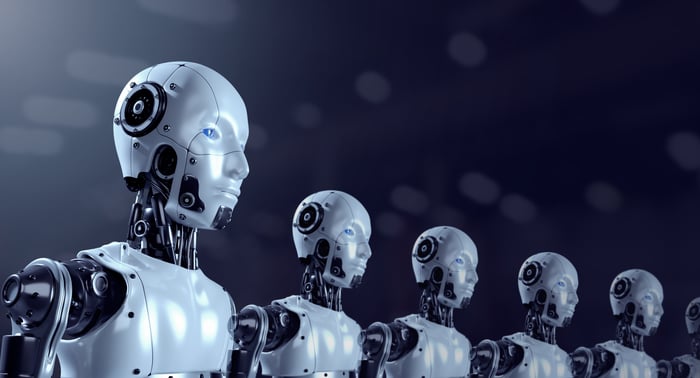
Image source: Getty Images.
But the biggest opportunities here aren’t necessarily in the robot manufacturers themselves. Instead, they may lie with the companies that supply the AI and computing hardware that every humanoid robot will require.
Nvidia already owns the brains
Nvidia (NASDAQ: NVDA) has become one of the biggest beneficiaries of the humanoid robotics boom. While its GPUs already dominate AI training inside data centers, the company is now bringing those same capabilities into the physical world through its Isaac robotics platform, Jetson edge computers, and Omniverse simulation software.
Now, training a humanoid robot is quite similar to training a large language model. Before a robot can perform real-world tasks, it typically learns inside a digital simulation where it practices millions of movements without risking damage to expensive hardware. And Nvidia provides much of the computing infrastructure behind that process.
The company has also partnered with a number of robotics developers, including Figure AI, Agility Robotics, Boston Dynamics, and Foxconn, thereby positioning its technology near the center of the emerging robotics ecosystem.
Tesla is building the robot
Tesla (NASDAQ: TSLA) represents a very different opportunity. Rather than supplying components, Tesla intends to manufacture humanoid robots itself.
Its Optimus robot has progressed rapidly over the past two years, evolving from carefully scripted demonstrations into machines capable of performing increasingly complex tasks. The company is now actively preparing dedicated production capacity for Optimus at its Fremont factory after converting production lines previously used for the Model S and Model X. Management says the move is intended to support large-scale Optimus manufacturing as production ramps over the next few years.
Keep your expectations realistic, though. Meaningful revenue from humanoid robots is still years away. And manufacturing a reliable humanoid at automotive scale remains an enormous engineering challenge.
Why Nvidia and Tesla stand out
Dozens of companies are building humanoid robots. Figure AI, Agility Robotics, Unitree, UBTech, and several Chinese start-ups have all made impressive progress. But most remain privately held. Nvidia and Tesla offer something different.
Nvidia benefits regardless of which robot manufacturer ultimately wins because many developers rely on its AI hardware, simulation tools, and robotics software. Tesla, meanwhile, controls nearly every piece of the stack itself — from AI chips and neural networks to batteries, actuators, manufacturing, and software. If Optimus achieves large-scale commercial adoption, Tesla could capture substantially more value than companies supplying only individual components.
To be sure, humanoid robots are still in their earliest stages of development, and you should expect setbacks along the way. But the industry is beginning to transition from research labs into commercial production. And while this doesn’t guarantee success for every company involved, it does suggest that the opportunity is not centered on science fiction, anymore. It’s now moving into manufacturing. And when it comes to public companies, Nvidia and Tesla appear to be in the strongest position to benefit from that transition.
Don’t miss this second chance at a potentially lucrative opportunity
Ever feel like you missed the boat in buying the most successful stocks? Then you’ll want to hear this.
On rare occasions, our expert team of analysts issues a “Double Down” stock recommendation for companies that they think are about to pop. If you’re worried you’ve already missed your chance to invest, now is the best time to buy before it’s too late. And the numbers speak for themselves:
- Nvidia: if you invested $1,000 when we doubled down in 2009, you’d have $538,595!*
- Apple: if you invested $1,000 when we doubled down in 2008, you’d have $63,517!*
- Netflix: if you invested $1,000 when we doubled down in 2004, you’d have $400,964!*
Right now, we’re issuing “Double Down” alerts for three incredible companies, available when you join Stock Advisor, and there may not be another chance like this anytime soon.
*Stock Advisor returns as of July 17, 2026.
Jeff Siegel has no position in any of the stocks mentioned. The Motley Fool has positions in and recommends Nvidia and Tesla. The Motley Fool has a disclosure policy.
5 Stocks Our Experts Predict Could Double In the Next Year
By submitting your email, you'll also get a free pivot & flow membership. A free daily market overview. You can unsubscribe at any time.