Key Points
Investing in dividend stocks can be a good plan for people who want to earn steady income from their stock holdings. High-yield dividends often come from well-established, consistently profitable companies. If you want to avoid volatile growth stocks or put your money into parts of the market that might be less exposed to a possible downturn in tech stocks, buying high-yield dividend stocks can be a good strategy.
The Fidelity High Dividend ETF (NYSEMKT: FDVV) is a dividend stock ETF that invests in large- and mid-cap stocks of companies that are expected to continue to pay and grow their dividends.
Will AI create the world’s first trillionaire? Our team just released a report on the one little-known company, called an “Indispensable Monopoly” providing the critical technology Nvidia and Intel both need. Continue »
Here are a few key details about the Fidelity High Dividend ETF.

Image source: Getty Images.
FDVV: 112 holdings, but still tech-heavy
The Fidelity High Dividend ETF has 112 holdings, making it less diversified than many other ETFs. The fund’s dividend yield is 2.8%, and it charges an expense ratio of 0.15%.
Like many dividend ETFs, this fund offers decent sector diversification. Its holdings include 26.7% information technology stocks, 18.9% financials, 14.5% consumer discretionary, 11.3% consumer staples, and 9.2% utilities.
But the top four holdings (as of April 30) are all major tech names: Nvidia, Apple, Microsoft, and Broadcom. These four tech stocks make up about 20.5% of the fund. If you’re looking to diversify away from tech stocks, this dividend fund might not be the best choice.
Underperforming the S&P 500
The Fidelity High Dividend ETF was launched in September 2016. During that almost 10-year track record, it has delivered average annual returns (by net asset value) of 13.3%. That might sound like a solid return on investment.
Unfortunately, the S&P 500 index has done even better. If you had invested $10,000 in FDVV on its inception date, today you’d have about $23,540. But if you had invested $10,000 in an S&P 500 index fund instead, today you’d have about $33,790 — a 44% higher return.
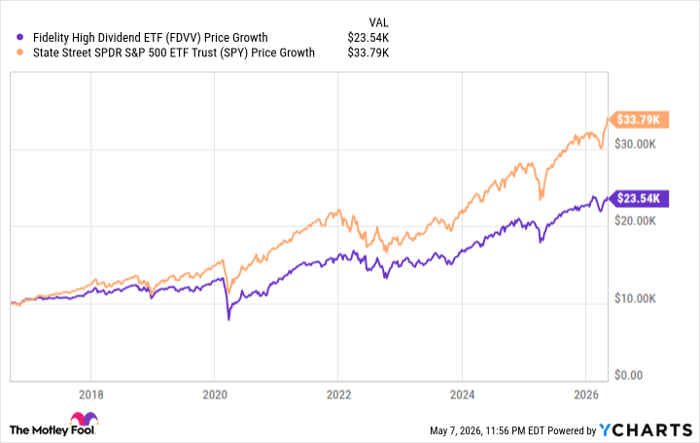
This fund has also underperformed the S&P 500 year to date and for the past five years. Past performance doesn’t guarantee future results, and this fund might rally and outperform the market in the years to come. But a dividend-focused fund that is top-heavy with tech stocks seems like an odd choice for most investors. This fund doesn’t rank among the best dividend ETFs.
What should you buy instead? If you want lots of tech stocks, buying a Nasdaq-100 ETF could be a better strategy. If you want more value-oriented stocks that pay high dividends, other dividend ETFs could be a better fit. Or if you want more diversification, choosing a low-cost total stock market index fund might help you avoid the risks of investing too heavily in any one industry or type of stock.
Should you buy stock in Fidelity Covington Trust – Fidelity High Dividend ETF right now?
Before you buy stock in Fidelity Covington Trust – Fidelity High Dividend ETF, consider this:
The Motley Fool Stock Advisor analyst team just identified what they believe are the 10 best stocks for investors to buy now… and Fidelity Covington Trust – Fidelity High Dividend ETF wasn’t one of them. The 10 stocks that made the cut could produce monster returns in the coming years.
Consider when Netflix made this list on December 17, 2004… if you invested $1,000 at the time of our recommendation, you’d have $471,827!* Or when Nvidia made this list on April 15, 2005… if you invested $1,000 at the time of our recommendation, you’d have $1,319,291!*
Now, it’s worth noting Stock Advisor’s total average return is 986% — a market-crushing outperformance compared to 207% for the S&P 500. Don’t miss the latest top 10 list, available with Stock Advisor, and join an investing community built by individual investors for individual investors.
*Stock Advisor returns as of May 10, 2026.
Ben Gran has no position in any of the stocks mentioned. The Motley Fool has positions in and recommends Apple, Broadcom, Microsoft, and Nvidia. The Motley Fool has a disclosure policy.
5 Stocks Our Experts Predict Could Double In the Next Year
By submitting your email, you'll also get a free pivot & flow membership. A free daily market overview. You can unsubscribe at any time.